
Revista Biomédica Revisada Por Pares

 Para Descargar PDF debe Abrir sesión.
Helicobacter pylori infection has been implicated as trigger or disease modifier in immune thrombocytopenia (ITP). So, eradication treatment for this agent could have clinical benefits. Searching in Epistemonikos database, which is maintained by screening 30 databases, we identified four systematic reviews comprising 40 studies addressing the question of this article overall, including one randomized controlled trial. We combined the evidence using meta-analysis and generated a summary of findings following the GRADE approach. We concluded Helicobacter eradication might decrease risk of bleeding in patients with immune thrombocytopenia but the certainty of the evidence is low.
Helicobacter pylori is known for its influence on the development of gastrointestinal diseases. However, it could also play a role in diseases outside the digestive system such as immune thrombocytopenia (also called idiopathic or immune thrombocytopenic purpura - ITP). This condition is characterized by the presence of antibodies against platelets, and it has been postulated Helicobacter might act as a trigger, and also as a disease modulator by a mechanism not completely understood.
For this reason, it has been suggested eradication of Helicobacter could be beneficial. However, it is unclear whether this actually translates into clinical benefits.
We used Epistemonikos database, which is maintained by screening more than 30 databases, to identify systematic reviews and their included primary studies. With this information we generated a structured summary using a pre-established format, which includes key messages, a summary of the body of evidence (presented as an evidence matrix in Epistemonikos), meta-analysis of the total of studies, a summary of findings table following the GRADE approach and a table of other considerations for decision-making.
|
Key messages
|
|
What is the evidence. |
We found four systematic reviews [1], [2], [3], [4], including 40 studies addressing the question of interest [5], [6], [7], [8] ,[9], [10], [11], [12],[13], [14], [15], [16], [17], [18], [19], [20], [21], [22], [23], [24], [25], [26], [27], [28], [29], [30], [31], [32], [33], [34], [35], [36], |
|
What types of patients were included |
The trial included adult patients between 18 and 75, with chronic immune thrombocytopenia and Helicobacter pylori infection confirmed with urea breath test. Patients were included only if secondary causes of thrombocytopenia had been clearly ruled out, including hepatitis B or C virus infection, HIV infection, lupus, antiphospholipid antibody syndrome, bone marrow failure syndromes, drug-induced thrombocytopenia, and malignancies such as chronic lymphocytic leukemia and malignant lymphoma.Patients with renal failure, severe liver failure, allergic to amoxicillin, clarithromycin or lansoprazole and patients with platelet counts below 20 x 103/µl or above 100 x 103/µl were also excluded. |
|
What types of interventions were included |
The trial evaluated eradication of Helicobacter pylori with amoxicillin 750 mg, clarithromycin 200 mg and lansoprazole 30 mg bid for one week. The trial compared against placebo. |
|
What types of outcomes |
All of the systematic reviews evaluated only considered the outcome platelet response, measured in different ways. The randomized trial defined a platelet count of 150 x 103/µl as complete response and a partial response over 50 x 103/µl. |
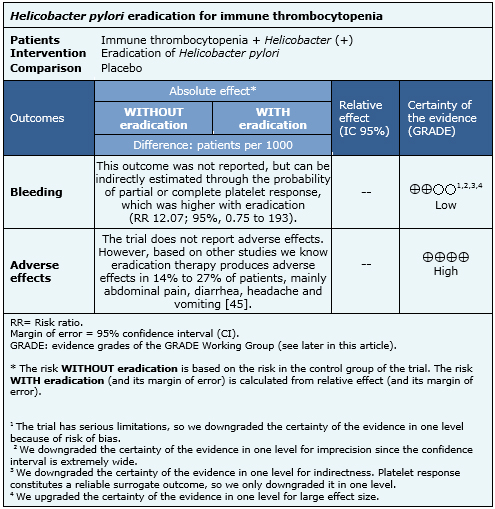
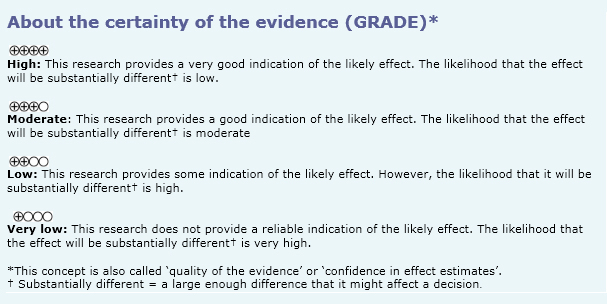
The Information on the effects of Helicobacter pylori eradication in patients with immune thrombocytopenia is based in only one randomized trial including 25 participants [32]. The trial measured increase in platelet count after the eradication of Helicobacter pylori, which was used as indirect evidence of the effect on the risk of bleeding. The summary of findings is as follows:
|
To whom this evidence does and does not apply |
|
| About the outcomes included in this summary |
|
| Balance between benefits and risks, and certainty of the evidence |
|
| What would patients and their doctors think about this intervention |
|
| Resource considerations |
|
|
Differences between this summary and other sources |
|
| Could this evidence change in the future? |
|
Using automated and collaborative means, we compiled all the relevant evidence for the question of interest and we present it as a matrix of evidence.
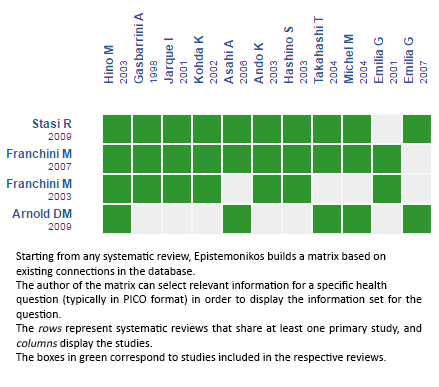
Follow the link to access the interactive version: Helicobacter pylori eradication for immune thrombocytopenia (ITP)
The upper portion of the matrix of evidence will display a warning of “new evidence” if new systematic reviews are published after the publication of this summary. Even though the project considers the periodical update of these summaries, users are invited to comment in Medwave or to contact the authors through email if they find new evidence and the summary should be updated earlier. After creating an account in Epistemonikos, users will be able to save the matrixes and to receive automated notifications any time new evidence potentially relevant for the question appears.
The details about the methods used to produce these summaries are described here http://dx.doi.org/10.5867/medwave.2014.06.5997.
Epistemonikos foundation is a non-for-profit organization aiming to bring information closer to health decision-makers with technology. Its main development is Epistemonikos database (www.epistemonikos.org).
These summaries follow a rigorous process of internal peer review.
Conflicts of interest
The authors do not have relevant interests to declare.
 Esta obra de Medwave está bajo una licencia Creative Commons Atribución-NoComercial 3.0 Unported. Esta licencia permite el uso, distribución y reproducción del artículo en cualquier medio, siempre y cuando se otorgue el crédito correspondiente al autor del artículo y al medio en que se publica, en este caso, Medwave.
Helicobacter pylori infection has been implicated as trigger or disease modifier in immune thrombocytopenia (ITP). So, eradication treatment for this agent could have clinical benefits. Searching in Epistemonikos database, which is maintained by screening 30 databases, we identified four systematic reviews comprising 40 studies addressing the question of this article overall, including one randomized controlled trial. We combined the evidence using meta-analysis and generated a summary of findings following the GRADE approach. We concluded Helicobacter eradication might decrease risk of bleeding in patients with immune thrombocytopenia but the certainty of the evidence is low.
Autores:
Valentina Llovet[1,2], Gabriel Rada[2,3,4,5,6]
Citación: Llovet V, Rada G. Does Helicobacter pylori eradication play a role in immune thrombocytopenia?. Medwave 2016;16(Suppl3):e6528 doi: 10.5867/medwave.2016.6528
Fecha de publicación: 5/9/2016
Nos complace que usted tenga interés en comentar uno de nuestros artículos. Su comentario será publicado inmediatamente. No obstante, Medwave se reserva el derecho a eliminarlo posteriormente si la dirección editorial considera que su comentario es: ofensivo en algún sentido, irrelevante, trivial, contiene errores de lenguaje, contiene arengas políticas, obedece a fines comerciales, contiene datos de alguna persona en particular, o sugiere cambios en el manejo de pacientes que no hayan sido publicados previamente en alguna revista con revisión por pares.
Aún no hay comentarios en este artículo.
Para comentar debe iniciar sesión
Medwave publica las vistas HTML y descargas PDF por artículo, junto con otras métricas de redes sociales.
Arnold DM, Bernotas A, Nazi I, Stasi R, Kuwana M, Liu Y, et al. Platelet count response to H. pylori treatment in patients with immune thrombocytopenic purpura with and without H. pylori infection: a systematic review. Haematologica. 2009 Jun;94(6):850-6. | CrossRef | PubMed |Franchini M, Cruciani M, Mengoli C, Pizzolo G, Veneri D. Effect of Helicobacter pylori eradication on platelet count in idiopathic thrombocytopenic purpura: a systematic review and meta-analysis. J Antimicrob Chemother. 2007 Aug;60(2):237-46. | PubMed |Stasi R, Sarpatwari A, Segal JB, Osborn J, Evangelista ML, Cooper N, et al. Effects of eradication of Helicobacter pylori infection in patients with immune thrombocytopenic purpura: a systematic review. Blood. 2009 Feb 5;113(6):1231-40. | CrossRef | PubMed |Franchini M, Veneri D. Helicobacter pylori infection and immune thrombocytopenic purpura: an update. Helicobacter. 2004 Aug;9(4):342-6. | PubMed |Ahn ER, Tiede MP, Jy W, Bidot CJ, Fontana V, Ahn YS. Platelet activation in Helicobacter pylori-associated idiopathic thrombocytopenic purpura: eradication reduces platelet activation but seldom improves platelet counts. Acta Haematol. 2006;116(1):19-24. | PubMed |Ando K, Shimamoto T, Tauchi T, Ito Y, Kuriyama Y, Gotoh A, et al. Can eradication therapy for Helicobacter pylori really improve the thrombocytopenia in idiopathic thrombocytopenic purpura? Our experience and a literature review. Int J Hematol. 2003 Apr;77(3):239-44. | PubMed |Ando T, Tsuzuki T, Mizuno T, Minami M, Ina K, Kusugami K, et al. Characteristics of Helicobacter pylori-induced gastritis and the effect of H. pylori eradication in patients with chronic idiopathic thrombocytopenic purpura. Helicobacter. 2004 Oct;9(5):443-52. | PubMed |Asahi A, Kuwana M, Suzuki H, Hibi T, Kawakami Y, Ikeda Y. Effects of a Helicobacter pylori eradication regimen on anti-platelet autoantibody response in
infected and uninfected patients with idiopathic thrombocytopenic purpura. Haematologica. 2006 Oct;91(10):1436-7. | PubMed |Campuzano-Maya G. Proof of an association between Helicobacter pylori and idiopathic thrombocytopenic purpura in Latin America. Helicobacter. 2007 Jun;12(3):265-73. | PubMed |Emilia G, Longo G, Luppi M, Gandini G, Morselli M, Ferrara L, et al. Helicobacter pylori eradication can induce platelet recovery in idiopathic thrombocytopenic purpura. Blood. 2001 Feb 1;97(3):812-4. | PubMed |Emilia G, Luppi M, Zucchini P, Morselli M, Potenza L, Forghieri F, et al. Helicobacter pylori infection and chronic immune thrombocytopenic purpura: long-term results of bacterium eradication and association with bacterium virulence profiles. Blood. 2007 Dec 1;110(12):3833-41. | PubMed |Estrada-Gómez RA, Parra-Ortega I, Martínez-Barreda C, Ruiz-Argüelles GJ. Helicobacter pylori infection and thrombocytopenia: a single-institution experience in Mexico. Rev Invest Clin. 2007 Mar-Apr;59(2):112-5. | PubMed |Fujimura K, Kuwana M, Kurata Y, Imamura M, Harada H, Sakamaki H, et al. Is eradication therapy useful as the first line of treatment in Helicobacter pylori-positive idiopathic thrombocytopenic purpura? Analysis of 207 eradicated chronic ITP cases in Japan. Int J Hematol. 2005 Feb;81(2):162-8. | PubMed |Gasbarrini A, Franceschi F, Tartaglione R, Landolfi R, Pola P, Gasbarrini G. Regression of autoimmune thrombocytopenia after eradication of Helicobacter
pylori. Lancet. 1998 Sep 12;352(9131):878. | PubMed |Hashino S, Mori A, Suzuki S, Izumiyama K, Kahata K, Yonezumi M, et al. Platelet recovery in patients with idiopathic thrombocytopenic purpura after eradication of Helicobacter pylori. Int J Hematol. 2003 Feb;77(2):188-91. | PubMed |Hino M, Yamane T, Park K, Takubo T, Ohta K, Kitagawa S, et al. Platelet recovery after eradication of Helicobacter pylori in patients with idiopathic thrombocytopenic purpura. Ann Hematol. 2003 Jan;82(1):30-2. | PubMed |Inaba T, Mizuno M, Take S, Suwaki K, Honda T, Kawai K, et al. Eradication of Helicobacter pylori increases platelet count in patients with idiopathic thrombocytopenic purpura in Japan. Eur J Clin Invest. 2005 Mar;35(3):214-9. | PubMed |Jackson SC, Beck P, Buret AG, O'Connor PM, Meddings J, et al. Long term platelet responses to Helicobacter pylori eradication in Canadian patients with immune thrombocytopenic purpura. Int J Hematol. 2008 Sep;88(2):212-8. | CrossRef | PubMed |Jarque I, Andreu R, Llopis I, De la Rubia J, Gomis F, Senent L, et al. Absence of platelet response after eradication of Helicobacter pylori infection in patients with chronic idiopathic thrombocytopenic purpura. Br J Haematol. 2001 Dec;115(4):1002-3. | PubMed |Kato A, Kato H, Hirashima N, Sakamoto T, Nukaya H, Ito K, et al. [Evaluation of the efficacy of an Helicobacter pylori eradication treatment for idiopathic thrombocytopenic purpura patients]. Nihon Shokakibyo Gakkai Zasshi. 2004 Nov;101(11):1209-16. | PubMed |Kodama M, Kitadai Y, Ito M, Kai H, Masuda H, Tanaka S, et al. Immune response to CagA protein is associated with improved platelet count after Helicobacter pylori eradication in patients with idiopathic thrombocytopenic purpura. Helicobacter. 2007 Feb;12(1):36-42. | PubMed |Kohda K, Kuga T, Kogawa K, Kanisawa Y, Koike K, Kuroiwa G, et al. Effect of Helicobacter pylori eradication on platelet recovery in Japanese patients with chronic idiopathic thrombocytopenic purpura and secondary autoimmune thrombocytopenic purpura. Br J Haematol. 2002 Aug;118(2):584-8. | PubMed |Michel M, Cooper N, Jean C, Frissora C, Bussel JB. Does Helicobater pylori initiate or perpetuate immune thrombocytopenic purpura? Blood. 2004 Feb 1;10(3):890-6. | PubMed |Morimoto N, Takeuchi H, Takahashi T, Ueta T, Tanizawa Y, Kumon Y, et al. Helicobacter pylori-associated chronic idiopathic thrombocytopenic purpura and low molecular weight H. pylori proteins. Scand J Infect Dis. 2007;39(5):409-16. | PubMed |Nomura S, Inami N, Kanazawa S. The effects of Helicobacter pylori eradication on chemokine production in patients with immune thrombocytopenic purpura. Eur J Haematol. 2004 Apr;72(4):304-5. | PubMed |Ohguchi H, Kameoka J, Harigae H, Yamada M, Tomiya Y, Takahashi S, et al. Can the Helicobacter pylori eradication regimen induce platelet recovery in H. pylori-negative patients with idiopathic thrombocytopenic purpura? Am J Hematol. 2005 Feb;78(2):164-5. | PubMed |Satake M, Nishikawa J, Fukagawa Y, Akashi K, Okamoto T, Yoshida T, et al. The long-term efficacy of Helicobacter pylori eradication therapy in patients with idiopathic thrombocytopenic purpura. J Gastroenterol Hepatol. 2007 Dec;22(12):2233-7. | PubMed |Sato R, Murakami K, Watanabe K, Okimoto T, Miyajima H, Ogata M, et al. Effect of Helicobacter pylori eradication on platelet recovery in patients with chronic idiopathic thrombocytopenic purpura. Arch Intern Med. 2004 Sep 27;164(17):1904-7. | PubMed |Sayan O, Akyol Erikci A, Ozturk A. The Efficacy of Helicobacter pylori eradication in the treatment of idiopathic thrombocytopenic purpura--the first study in Turkey. Acta Haematol. 2006;116(2):146-9. | PubMed |Stasi R, Rossi Z, Stipa E, Amadori S, Newland AC, Provan D. Helicobacter pylori eradication in the management of patients with idiopathic thrombocytopenic purpura. Am J Med. 2005 Apr;118(4):414-9. | PubMed |Suvajdzić N, Stanković B, Artiko V, Cvejić T, Bulat V, Bakrac M, et al. Helicobacter pylori eradication can induce platelet recovery in chronic idiopathic thrombocytopenic purpura. Platelets. 2006 Jun;17(4):227-30. | PubMed |Suzuki T, Matsushima M, Masui A, Watanabe K, Takagi A, Ogawa Y, et al. Effect of Helicobacter pylori eradication in patients with chronic idiopathic thrombocytopenic purpura-a randomized controlled trial. Am J Gastroenterol. 2005 Jun;100(6):1265-70. | PubMed |Takahashi T, Yujiri T, Shinohara K, Inoue Y, Sato Y, Fujii Y, et al. Molecular mimicry by Helicobacter pylori CagA protein may be involved in the pathogenesis
of H. pylori-associated chronic idiopathic thrombocytopenic purpura. Br J Haematol. 2004 Jan;124(1):91-6. | PubMed |Veneri D, De Matteis G, Solero P, Federici F, Zanuso C, Guizzardi E, et al. Analysis of B- and T-cell clonality and HLA class II alleles in patients with idiopathic thrombocytopenic purpura: correlation with Helicobacter pylori infection and response to eradication treatment. Platelets. 2005 Aug;16(5):307-11. | PubMed |Veneri D, Franchini M, Gottardi M, D'Adda M, Ambrosetti A, Krampera M, e al. Efficacy of Helicobacter pylori eradication in raising platelet count in adult patients with idiopathic thrombocytopenic purpura. Haematologica. 2002 Nov;87(11):1177-9. | PubMed |Veneri D, Krampera M, Franchini M. High prevalence of sustained remission of idiopathic thrombocytopenic purpura after Helicobacter pylori eradication: a long-term follow-up study. Platelets. 2005 Mar;16(2):117-9. | PubMed |Tohda S, Ohkusa T. Resolution of refractory idiopathic thrombocytopenic purpura after eradication of Helicobacter pylori. Am J Hematol. 2000 Dec;65(4):329-30. | PubMed |Soldinger E, Pilia MC, Piubello W, Nadali G. Multi-resistant idiopathic thrombocytopenia successfully treated by eradication of Helicobacter pylori. Dig Liver Dis. 2001 Nov;33(8):732. | PubMed |Mukai M, Kon Y, Notoya A, Kohno M. Helicobacter pylori associated with idiopathic thrombocytopenic purpura. Am J Med. 2002 Aug 1;113(2):169-71. | PubMed |Michel M, Khellaf M, Desforges L, Lee K, Schaeffer A, Godeau B, Bierling P. Autoimmune thrombocytopenic Purpura and Helicobacter pylori infection. Arch Intern Med. 2002 May 13;162(9):1033-6. | PubMed |Kumagai T, Sekigawa K, Hashimoto N, Shirato R. Remission of idiopathic thrombocytopenic purpura by eradicating Helicobacter pylori after omeprazole monotherapy. Int J Hematol. 2001 Aug;74(2):237-8. | PubMed |Grimaz S, Damiani D, Brosolo P, Skert C, Geromin A, de Pretis G. Resolution of thrombocytopenia after treatment for Helicobacter pylori: a case report. Haematologica. 1999 Mar;84(3):283-4. | PubMed |García Pérez A, Valverde de La Osa J, Giménez Samper M, Alonso García I. [Resolution of an autoimmune thrombocytopenic purpura after eradicating treatment of Helicobacter pylori]. Sangre (Barc). 1999 Oct;44(5):387-8. | PubMed |Emilia G, Luppi M, Morselli M, Potenza L, D'Apollo N, Torelli G. Helicobacter pylori infection and idiopathic thrombocytopenic purpura. Br J Haematol. 2002 Sep;118(4):1198-9. | PubMed |Li BZ, Threapleton DE, Wang JY, Xu JM, Yuan JQ, Zhang C, et al. Comparative effectiveness and tolerance of treatments for Helicobacter pylori: systematic review and network meta-analysis. BMJ. 2015 Aug 19;351:h4052. | CrossRef | PubMed |Neunert C, Lim W, Crowther M, Cohen A, Solberg L Jr, Crowther MA, et al. The American Society of Hematology 2011 evidence-based practice guideline for immune thrombocytopenia. Blood. 2011 Apr 21;117(16):4190-207. | CrossRef | PubMed |Rohani Hospital. The effect of Helicobacter pylori eradication on recovery of platelet level in Idiopathic Trombocytopenic purpura patients. Iranian Registry of Clinical Trials. IRCT201202098968N1. 2012. Mahidol University. Helicobacter Pylori Infection in Children With Chronic Idiopathic Thrombocytopenic Purpura. clinicaltrials.gov. 2006; Federal University of São Paulo. Helicobacter Pylori Treatment in Immune Thrombocytopenic Purpura (ITP) Patients. clinicaltrials.gov. 2008. Brito HS, Braga JA, Loggetto SR, Machado RS, Granato CF, Kawakami E. Helicobacter pylori infection & immune thrombocytopenic purpura in children and adolescents: A randomized controlled trial. Platelets. 2015;26(4):336-41. | CrossRef | PubMed |Tang Y, Wang SC, Wang LJ, Liu Y, Wang HY, Wang ZJ. [Clinical significance of Helicobacter pylori in children with idiopathic thrombocytopenic purpura]. Zhongguo Shi Yan Xue Ye Xue Za Zhi. 2013 Apr;21(2):419-21. | CrossRef | PubMed |Li CX, Liu DJ, Pan CQ, Sang XF, Li X. [Effect of Helicobacter pylori eradication on childhood acute idiopathic thrombocytopenic purpura]. Nan Fang Yi Ke Da Xue Xue Bao. 2009 Jun;29(6):1243-4. | PubMed |Treepongkaruna S, Sirachainan N, Kanjanapongkul S, Winaichatsak A, Sirithorn S, Sumritsopak R, et al. Absence of platelet recovery following Helicobacter pylori eradication in childhood chronic idiopathic thrombocytopenic purpura: a multi-center randomized controlled trial. Pediatr Blood Cancer. 2009 Jul;53(1):72-7. | CrossRef | PubMed |






 Estudios originales