

Resumen
Este resumen Epistemonikos (Living FRISBEE: Living FRIendly Summary of the Body of Evidence using Epistemonikos) es una actualización del resumen publicado en Abril de 2015, basado en una nueva revisión sistemática aparecida en mayo de 2015.
Sobre la actualización
Este artículo actualiza el resumen (Living FRISBEE: Living FRIendly Summary of the Body of Evidence using Epistemonikos) de abril de 2015 (doi: 10.5867/medwave.2015.03.6129) debido a la reciente disponibilidad de una nueva revisión sistemática, posterior a la publicación del artículo original [1]
La nueva evidencia incorporada en este resumen llevó a disminuir la certeza de la evidencia para el desenlace mortalidad de baja a muy baja, y en consecuencia a cambios en los mensajes clave y en las consideraciones para la toma de decisión.
Problema
Los digitálicos son drogas ampliamente utilizadas desde hace más de dos siglos. Sin embargo, el verdadero rol que juegan en el tratamiento de la insuficiencia cardíaca es controvertido. Por un lado, producirían una mejoría sintomática y aumentarían la tolerancia al ejercicio, pero por otro podrían aumentar la mortalidad, especialmente cuando existe enfermedad isquémica, y tienen un alto riesgo de efectos adversos.
Métodos
Utilizamos la base de datos Epistemonikos, la cual es mantenida mediante búsquedas en 30 bases de datos, para identificar revisiones sistemáticas y sus estudios primarios incluidos. Con esta información generamos un resumen estructurado, siguiendo un formato preestablecido, que incluye mensajes clave, un resumen del conjunto de evidencia (presentado como matriz de evidencia en Epistemonikos), metanálisis del total de los estudios, tablas de resumen de resultados con el método GRADE, y tabla de otras consideraciones para la toma de decisión.
|
Mensajes clave
|
Acerca del conjunto de evidencia para esta pregunta
|
Cuál es la evidencia. |
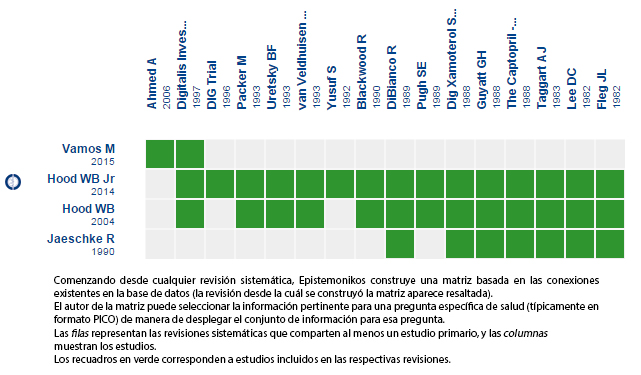
Encontramos cuatro revisiones sistemáticas [1–4] que incluyen 13 estudios controlados aleatorizados reportados en 16 artículos [5–20]. |
|
Qué tipo de pacientes incluyeron los estudios |
Todos los estudios incluyeron pacientes con insuficiencia cardiaca de cualquier etiología, siendo la más frecuente isquémica. Todos los estudios incluyeron pacientes en ritmo sinusal. El promedio de edad de los pacientes incluidos osciló entre 58 y 69 años. |
|
Qué tipo de intervenciones incluyeron los estudios |
Todos los estudios utilizaron digoxina, ocho de ellos con una dosis titulada [5,9,10,14,16–19]. Todos los estudios compararon contra placebo. |
|
Qué tipo de desenlaces midieron |
Muerte por cualquier causa o por empeoramiento de la insuficiencia cardiaca; hospitalización por cualquier causa o por falla cardiaca, visitas al servicio de urgencia, deterioro clínico, calidad de vida, test de caminata, marcadores neurohumorales y parámetros ecocardiográficos. |
Resumen de los resultados
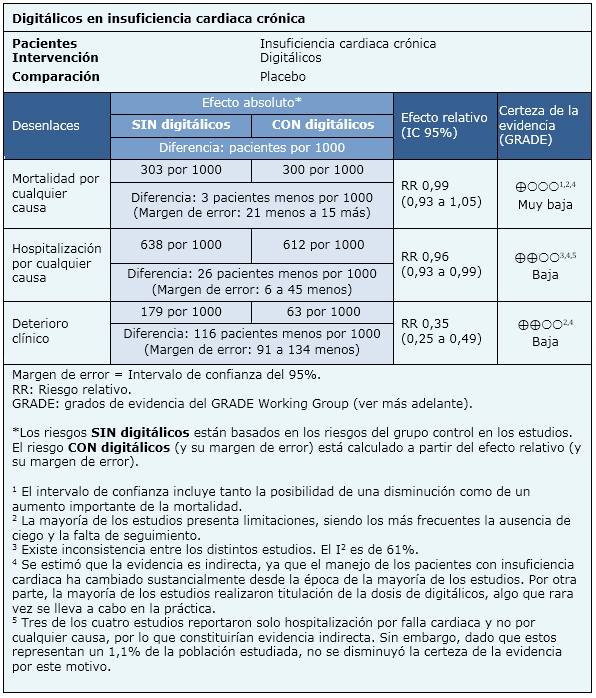
La información sobre los efectos de los digitálicos está basada en 13 estudios aleatorizados que incluyen 9022 pacientes. Sólo ocho estudios reportaron mortalidad total, uno hospitalización por cualquier causa, cuatro reportaron hospitalización por falla cardiaca, y 12 reportaron deterioro clínico.
- Existe incertidumbre sobre si el uso de digitálicos disminuye o aumenta la mortalidad en pacientes con insuficiencia cardiaca porque la certeza de la evidencia es muy baja.
- El uso de digitálicos podría disminuir las hospitalizaciones por cualquier causa y el deterioro clínico. La certeza de la evidencia es baja.
Otras consideraciones para la toma de decisión
|
A quién se aplica y a quién no se aplica esta evidencia |
|
| Sobre los desenlaces incluidos en este resumen |
|
| Balance riesgo/beneficio y certeza de la evidencia |
|
| Consideraciones de recursos |
|
|
Qué piensan los pacientes y sus tratantes |
|
|
Diferencias entre este resumen y otras fuentes |
|
| ¿Puede que cambie esta información en el futuro? |
|
Cómo realizamos este resumen
Mediante métodos automatizados y colaborativos recopilamos toda la evidencia relevante para la pregunta de interés y la presentamos en una matriz de evidencia.
Siga el enlace para acceder a la versión interactiva Digitalis for chronic heart failure
Notas
Si con posterioridad a la publicación de este resumen se publican nuevas revisiones sistemáticas sobre este tema, en la parte superior de la matriz se mostrará un aviso de “nueva evidencia”. Si bien el proyecto contempla la actualización periódica de estos resúmenes, los usuarios están invitados a comentar en Medwave o contactar a los autores mediante correo electrónico si creen que hay evidencia que motive una actualización más rápida.
Luego de crear una cuenta en Epistemonikos, al guardar las matrices recibirá notificaciones automáticas cada vez que exista nueva evidencia que potencialmente responda a esta pregunta. El detalle de los métodos para elaborar este resumen están descritos aquí: http://dx.doi.org/10.5867/medwave.2014.06.5997.
La Fundación Epistemonikos es una organización que busca acercar la información a quienes toman decisiones en salud, mediante el uso de tecnologías. Su principal desarrollo es la base de datos Epistemonikos (www.epistemonikos.org).
Los resúmenes de evidencia siguen un riguroso proceso de revisión por pares interno.
Declaración de conflictos de intereses
Los autores declaran no tener conflictos de intereses con la materia de este artículo.

 Matriz de evidencia
 Esta obra de Medwave está bajo una licencia Creative Commons Atribución-NoComercial 3.0 Unported. Esta licencia permite el uso, distribución y reproducción del artículo en cualquier medio, siempre y cuando se otorgue el crédito correspondiente al autor del artículo y al medio en que se publica, en este caso, Medwave.
Este resumen Epistemonikos (Living FRISBEE: Living FRIendly Summary of the Body of Evidence using Epistemonikos) es una actualización del resumen publicado en Abril de 2015, basado en una nueva revisión sistemática aparecida en mayo de 2015.
Authors:
Carmen Rain[1], Gabriel Rada[1,2,3,4,5]
Affiliation:
[1] Programa de Salud Basada en Evidencia, Facultad de Medicina, Pontificia Universidad Católica de Chile
[2] Departamento de Medicina Interna, Facultad de Medicina, Pontificia Universidad Católica de Chile
[3] GRADE working group
[4] The Cochrane Collaboration
[5] Fundación Epistemonikos
E-mail: radagabriel@epistemonikos.org
Citation: Rain C, Rada G. Is there a role for digitalis in chronic heart failure? –First update. Medwave 2015 Jun;15(suppl 1):e6148 doi: 10.5867/medwave.2015.6148
Publication date: 8/6/2015
Comments (0)
We are pleased to have your comment on one of our articles. Your comment will be published as soon as it is posted. However, Medwave reserves the right to remove it later if the editors consider your comment to be: offensive in some sense, irrelevant, trivial, contains grammatical mistakes, contains political harangues, appears to be advertising, contains data from a particular person or suggests the need for changes in practice in terms of diagnostic, preventive or therapeutic interventions, if that evidence has not previously been published in a peer-reviewed journal.
No comments on this article.
To comment please log in
Medwave provides HTML and PDF download counts as well as other harvested interaction metrics. There may be a 48-hour delay for most recent metrics to be posted.
- Vamos M, Erath JW, Hohnloser SH. Digoxin-associated mortality: a systematic review and meta-analysis of the literature. Eur Heart J. 2015 May 4. pii: ehv143. | PubMed | Link |
- Hood WB Jr, Dans AL, Guyatt GH, Jaeschke R, McMurray JJ. Digitalis for treatment of congestive heart failure in patients in sinus rhythm: a systematic review and meta-analysis. J Card Fail. 2004 Apr;10(2):155-64 | PubMed |
- Hood WB Jr, Dans AL, Guyatt GH, Jaeschke R, McMurray JJ. Digitalis for treatment of heart failure in patients in sinus rhythm. Cochrane Database Syst Rev. 2014 Apr 28;4:CD002901 | CrossRef | PubMed |
- Jaeschke R, Oxman AD, Guyatt GH. To what extent do congestive heart failure patients in sinus rhythm benefit from digoxin therapy? A systematic overview and meta-analysis. Am J Med. 1990 Mar;88(3):279-86. | PubMed | Link |
- Comparative effects of therapy with captopril and digoxin in patients with mild to moderate heart failure. The Captopril-Digoxin Multicenter Research Group. JAMA. 1988 Jan 22-29;259(4):539-44. | PubMed |
- Blackwood R, Mayou RA, Garnham JC, Armstrong C, Bryant B. Exercise capacity and quality of life in the treatment of heart failure. Clin Pharmacol Ther. 1990 Sep;48(3):325-32. | PubMed |
- Pugh SE, White NJ, Aronson JK, Grahame-Smith DG, Bloomfield JG. Clinical, haemodynamic, and pharmacological effects of withdrawal and reintroduction of digoxin in patients with heart failure in sinus rhythm after long term treatment. Br Heart J. 1989 Jun;61(6):529-39. | PubMed |
- DiBianco R, Shabetai R, Kostuk W, Moran J, Schlant RC, Wright R. A comparison of oral milrinone, digoxin, and their combination in the treatment of patients with chronic heart failure. N Engl J Med. 1989 Mar 16;320(11):677-83. | PubMed |
- Guyatt GH, Sullivan MJ, Fallen EL, Tihal H, Rideout E, Halcrow S, Nogradi S, Townsend M, Taylor DW. A controlled trial of digoxin in congestive heart failure. Am J Cardiol. 1988 Feb 1;61(4):371-5. | PubMed |
- Taggart AJ, Johnston GD, McDevitt DG. Digoxin withdrawal after cardiac failure in patients with sinus rhythm. J Cardiovasc Pharmacol. 1983 Mar-Apr;5(2):229-34. | PubMed |
- Rationale, design, implementation, and baseline characteristics of patients in the DIG trial: a large, simple, long-term trial to evaluate the effect of digitalis on mortality in heart failure. Control Clin Trials. 1996 Feb;17(1):77-97. | PubMed |
- Double-blind placebo-controlled comparison of digoxin and xamoterol in chronic heart failure. The German and Austrian Xamoterol Study Group. Lancet. 1988 Mar 5;1(8584):489-93. | PubMed |
- Yusuf S, Garg R, Held P, Gorlin R. Need for a large randomized trial to evaluate the effects of digitalis on morbidity and mortality in congestive heart failure. Am J Cardiol. 1992 Jun 4;69(18):64G-70G. | PubMed |
- van Veldhuisen DJ, Man in 't Veld AJ, Dunselman PH, Lok DJ, Dohmen HJ, Poortermans JC, Withagen AJ, et al. Double-blind placebo-controlled study of ibopamine and digoxin in patients with mild to moderate heart failure: results of the Dutch Ibopamine Multicenter Trial (DIMT). J Am Coll Cardiol. 1993 Nov 15;22(6):1564-73. | PubMed |
- Digitalis Investigation Group. The effect of digoxin on mortality and morbidity in patients with heart failure. N Engl J Med. 1997 Feb 20;336(8):525-33. | PubMed |
- Lee DC, Johnson RA, Bingham JB, Leahy M, Dinsmore RE, Goroll AH, Newell JB, Strauss HW, Haber E. Heart failure in outpatients: a randomized trial of digoxin versus placebo. N Engl J Med. 1982 Mar 25;306(12):699-705. | PubMed |
- Uretsky BF, Young JB, Shahidi FE, Yellen LG, Harrison MC, Jolly MK. Randomized study assessing the effect of digoxin withdrawal in patients with mild to moderate chronic congestive heart failure: results of the PROVED trial. PROVED Investigative Group. J Am Coll Cardiol. 1993 Oct;22(4):955-62. | PubMed |
- Packer M, Gheorghiade M, Young JB, Costantini PJ, Adams KF, Cody RJ, Smith LK, Van Voorhees L, Gourley LA, Jolly MK. Withdrawal of digoxin from patients with chronic heart failure treated with angiotensin-converting-enzyme inhibitors. RADIANCE Study. N Engl J Med. 1993 Jul 1;329(1):1-7. | PubMed |
- Fleg JL, Gottlieb SH, Lakatta EG. Is digoxin really important in treatment of compensated heart failure? A placebo-controlled crossover study in patients with sinus rhythm. Am J Med. 1982 Aug;73(2):244-50. | PubMed |
- Ahmed A, Rich MW, Fleg JL, Zile MR, Young JB, Kitzman DW, et al. Effects of digoxin on morbidity and mortality in diastolic heart failure: the ancillary digitalis investigation group trial. Circulation. 2006 Aug 1;114(5):397-403. Epub 2006 Jul 24. | PubMed |
- Moe GW, Ezekowitz JA, O'Meara E, Lepage S, Howlett JG, Fremes S, et al. The 2014 Canadian Cardiovascular Society Heart Failure Management Guidelines Focus Update: anemia, biomarkers, and recent therapeutic trial implications. Can J Cardiol. 2015 Jan;31(1):3-16. | PubMed |
- Heart Failure Society of America, Lindenfeld J, Albert NM, Boehmer JP, Collins SP, Ezekowitz JA, Givertz MM, Katz SD, Klapholz M, Moser DK, Rogers JG, Starling RC, Stevenson WG, Tang WH, Teerlink JR, Walsh MN. HFSA 2010 Comprehensive Heart Failure Practice Guideline. J Card Fail. 2010 Jun;16(6):e1-194. | CrossRef | PubMed |
- McMurray JJ, Adamopoulos S, Anker SD, Auricchio A, Böhm M, Dickstein K, et al. ESC Guidelines for the diagnosis and treatment of acute and chronic heart failure 2012: The Task Force for the Diagnosis and Treatment of Acute and Chronic Heart Failure 2012 of the European Society of Cardiology. Developed in collaboration with the Heart Failure Association (HFA) of the ESC. Eur Heart J. 2012 Jul;33(14):1787-847. | CrossRef | PubMed |
- Yancy CW, Jessup M, Bozkurt B, Butler J, Casey DE Jr, Drazner MH, et al. Task Force on Practice Guidelines. 2013 ACCF/AHA guideline for the management of heart failure: a report of the American College of Cardiology Foundation/American Heart Association Task Force on practice guidelines. Circulation. 2013 Oct 15;128(16):e240-327 | CrossRef | PubMed |
- Fleg JL, Gottlieb SH, Lakatta EG. Is digoxin really important in treatment of compensated heart failure? A placebo-controlled crossover study in patients with sinus rhythm. Am J Med. 1982 Aug;73(2):244-50. | PubMed |
Vamos M, Erath JW, Hohnloser SH. Digoxin-associated mortality: a systematic review and meta-analysis of the literature. Eur Heart J. 2015 May 4. pii: ehv143. | PubMed | Link |Hood WB Jr, Dans AL, Guyatt GH, Jaeschke R, McMurray JJ. Digitalis for treatment of congestive heart failure in patients in sinus rhythm: a systematic review and meta-analysis. J Card Fail. 2004 Apr;10(2):155-64 | PubMed |Hood WB Jr, Dans AL, Guyatt GH, Jaeschke R, McMurray JJ. Digitalis for treatment of heart failure in patients in sinus rhythm. Cochrane Database Syst Rev. 2014 Apr 28;4:CD002901 | CrossRef | PubMed |Jaeschke R, Oxman AD, Guyatt GH. To what extent do congestive heart failure patients in sinus rhythm benefit from digoxin therapy? A systematic overview and meta-analysis. Am J Med. 1990 Mar;88(3):279-86. | PubMed | Link |Comparative effects of therapy with captopril and digoxin in patients with mild to moderate heart failure. The Captopril-Digoxin Multicenter Research Group. JAMA. 1988 Jan 22-29;259(4):539-44. | PubMed |Blackwood R, Mayou RA, Garnham JC, Armstrong C, Bryant B. Exercise capacity and quality of life in the treatment of heart failure. Clin Pharmacol Ther. 1990 Sep;48(3):325-32. | PubMed |Pugh SE, White NJ, Aronson JK, Grahame-Smith DG, Bloomfield JG. Clinical, haemodynamic, and pharmacological effects of withdrawal and reintroduction of digoxin in patients with heart failure in sinus rhythm after long term treatment. Br Heart J. 1989 Jun;61(6):529-39. | PubMed |DiBianco R, Shabetai R, Kostuk W, Moran J, Schlant RC, Wright R. A comparison of oral milrinone, digoxin, and their combination in the treatment of patients with chronic heart failure. N Engl J Med. 1989 Mar 16;320(11):677-83. | PubMed |Guyatt GH, Sullivan MJ, Fallen EL, Tihal H, Rideout E, Halcrow S, Nogradi S, Townsend M, Taylor DW. A controlled trial of digoxin in congestive heart failure. Am J Cardiol. 1988 Feb 1;61(4):371-5. | PubMed |Taggart AJ, Johnston GD, McDevitt DG. Digoxin withdrawal after cardiac failure in patients with sinus rhythm. J Cardiovasc Pharmacol. 1983 Mar-Apr;5(2):229-34. | PubMed |Rationale, design, implementation, and baseline characteristics of patients in the DIG trial: a large, simple, long-term trial to evaluate the effect of digitalis on mortality in heart failure. Control Clin Trials. 1996 Feb;17(1):77-97. | PubMed |Double-blind placebo-controlled comparison of digoxin and xamoterol in chronic heart failure. The German and Austrian Xamoterol Study Group. Lancet. 1988 Mar 5;1(8584):489-93. | PubMed |Yusuf S, Garg R, Held P, Gorlin R. Need for a large randomized trial to evaluate the effects of digitalis on morbidity and mortality in congestive heart failure. Am J Cardiol. 1992 Jun 4;69(18):64G-70G. | PubMed |van Veldhuisen DJ, Man in 't Veld AJ, Dunselman PH, Lok DJ, Dohmen HJ, Poortermans JC, Withagen AJ, et al. Double-blind placebo-controlled study of ibopamine and digoxin in patients with mild to moderate heart failure: results of the Dutch Ibopamine Multicenter Trial (DIMT). J Am Coll Cardiol. 1993 Nov 15;22(6):1564-73. | PubMed |Digitalis Investigation Group. The effect of digoxin on mortality and morbidity in patients with heart failure. N Engl J Med. 1997 Feb 20;336(8):525-33. | PubMed |Lee DC, Johnson RA, Bingham JB, Leahy M, Dinsmore RE, Goroll AH, Newell JB, Strauss HW, Haber E. Heart failure in outpatients: a randomized trial of digoxin versus placebo. N Engl J Med. 1982 Mar 25;306(12):699-705. | PubMed |Uretsky BF, Young JB, Shahidi FE, Yellen LG, Harrison MC, Jolly MK. Randomized study assessing the effect of digoxin withdrawal in patients with mild to moderate chronic congestive heart failure: results of the PROVED trial. PROVED Investigative Group. J Am Coll Cardiol. 1993 Oct;22(4):955-62. | PubMed |Packer M, Gheorghiade M, Young JB, Costantini PJ, Adams KF, Cody RJ, Smith LK, Van Voorhees L, Gourley LA, Jolly MK. Withdrawal of digoxin from patients with chronic heart failure treated with angiotensin-converting-enzyme inhibitors. RADIANCE Study. N Engl J Med. 1993 Jul 1;329(1):1-7. | PubMed |Fleg JL, Gottlieb SH, Lakatta EG. Is digoxin really important in treatment of compensated heart failure? A placebo-controlled crossover study in patients with sinus rhythm. Am J Med. 1982 Aug;73(2):244-50. | PubMed |Ahmed A, Rich MW, Fleg JL, Zile MR, Young JB, Kitzman DW, et al. Effects of digoxin on morbidity and mortality in diastolic heart failure: the ancillary digitalis investigation group trial. Circulation. 2006 Aug 1;114(5):397-403. Epub 2006 Jul 24. | PubMed |Moe GW, Ezekowitz JA, O'Meara E, Lepage S, Howlett JG, Fremes S, et al. The 2014 Canadian Cardiovascular Society Heart Failure Management Guidelines Focus Update: anemia, biomarkers, and recent therapeutic trial implications. Can J Cardiol. 2015 Jan;31(1):3-16. | PubMed |Heart Failure Society of America, Lindenfeld J, Albert NM, Boehmer JP, Collins SP, Ezekowitz JA, Givertz MM, Katz SD, Klapholz M, Moser DK, Rogers JG, Starling RC, Stevenson WG, Tang WH, Teerlink JR, Walsh MN. HFSA 2010 Comprehensive Heart Failure Practice Guideline. J Card Fail. 2010 Jun;16(6):e1-194. | CrossRef | PubMed |McMurray JJ, Adamopoulos S, Anker SD, Auricchio A, Böhm M, Dickstein K, et al. ESC Guidelines for the diagnosis and treatment of acute and chronic heart failure 2012: The Task Force for the Diagnosis and Treatment of Acute and Chronic Heart Failure 2012 of the European Society of Cardiology. Developed in collaboration with the Heart Failure Association (HFA) of the ESC. Eur Heart J. 2012 Jul;33(14):1787-847. | CrossRef | PubMed |Yancy CW, Jessup M, Bozkurt B, Butler J, Casey DE Jr, Drazner MH, et al. Task Force on Practice Guidelines. 2013 ACCF/AHA guideline for the management of heart failure: a report of the American College of Cardiology Foundation/American Heart Association Task Force on practice guidelines. Circulation. 2013 Oct 15;128(16):e240-327 | CrossRef | PubMed |Fleg JL, Gottlieb SH, Lakatta EG. Is digoxin really important in treatment of compensated heart failure? A placebo-controlled crossover study in patients with sinus rhythm. Am J Med. 1982 Aug;73(2):244-50. | PubMed |





 Research papers
Systematization of initiatives in sexual and reproductive health about good practices criteria in response to the COVID-19 pandemic in primary health care in Chile
Clinical, psychological, social, and family characterization of suicidal behavior in Chilean adolescents: a multiple correspondence analysis
