

Abstract
Aiming to prevent thromboembolic events, bed rest has been historically considered in the management of patient with deep vein thrombosis. Nevertheless early ambulation could have beneficial effects. Searching in Epistemonikos database, which is maintained by screening 30 databases, we identified seven systematic reviews including 10 randomized trials answering this question. We combined the evidence using meta-analysis and generated a summary of findings table following the GRADE approach. We concluded early ambulation is probably effective in reducing deep vein thrombosis progression and improving limb pain, and might not increase the risk of thromboembolism.
Problem
Bed rest has been considered standard treatment of patients with deep venous thrombosis based on the assumption that rest decreases the risk of deep venous thrombus detachment and subsequent pulmonary embolism [1]. However, bed rest may have negative consequences, such as work absenteeism or morbidity associated with immobilization. In this context, it has been proposed that early mobilization might be a better alternative for these patients.
Methods
We used Epistemonikos database, which is maintained by screening more than 30 databases, to identify systematic reviews and their included primary studies. With this information we generated a structured summary using a pre-established format, which includes key messages, a summary of the body of evidence (presented as an evidence matrix in Epistemonikos), meta-analysis of the total of studies, a summary of findings table following the GRADE approach and a table of other considerations for decision-making.
|
Key messages
|
About the body of evidence for this question
|
What is the evidence. |
We found seven systematic reviews [2],[3],[4],[5],[6],[7],[8] considering 13 primary studies [9],[10],[11],[12],[13], [14],[15],[16],[17],[18],[19],[20],[21],[22],[23] including 10 randomized controlled trials [9],[10],[11],[12],[13],[14],[15],[16],[17],[18],[19],[20] and three observational studies [21],[22],[23]. This table and the analysis as a whole is based on the randomized controlled trials. |
|
What types of patients were included |
Patients with a diagnosis of acute deep vein thrombosis. |
|
What types of interventions were included |
Early ambulation compared with forced bed rest. Both strategies were associated with anticoagulation. |
|
What types of outcomes |
Pulmonary thromboembolism, death due to thromboembolic event, deep vein thrombosis progression and pain associated with deep vein thrombosis. |
Summary of findings
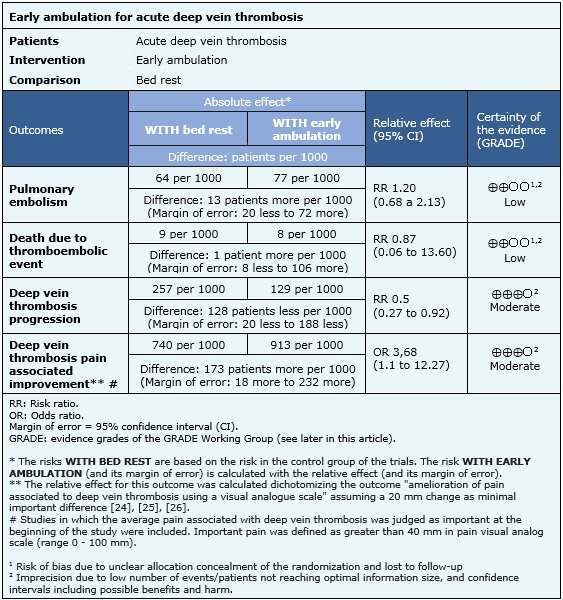
The information about the effects of early ambulation on deep vein thrombosis is based on 10 randomized controlled trials including 927 patients. Eight randomized controlled trials reported incidence of pulmonary embolism (including 863 patients), three trials reported death due to thromboembolic event (including 231 patients), three trials reported deep vein thrombosis progression (including 171 patients) and five trials reported pain associated with deep vein thrombosis (including 287 patients). The summary of findings is the following:
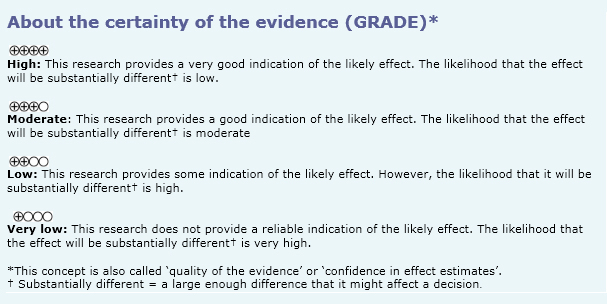
- Early ambulation probably results in improvement of pain associated with deep vein thrombosis. The certainty of the evidence is moderate.
- Early ambulation probably reduces the likelihood of progression of deep vein thrombosis. The certainty in the evidence is moderate.
- Early ambulation may not significantly increase the risk of pulmonary embolism in relation to the strategy of forced bed rest. The certainty of the evidence is low.
- Early ambulation may not significantly increase the risk of death due to a thromboembolic event in relation to the strategy of forced bed rest. The certainty of the evidence is low.
Other considerations for decision-making
|
To whom this evidence does and does not apply |
|
| About the outcomes included in this summary |
|
| Balance between benefits and risks, and certainty of the evidence |
|
| What would patients and their doctors think about this intervention |
|
| Resource considerations |
|
|
Differences between this summary and other sources |
|
| Could this evidence change in the future? |
|
How we conducted this summary
Using automated and collaborative means, we compiled all the relevant evidence for the question of interest and we present it as a matrix of evidence.
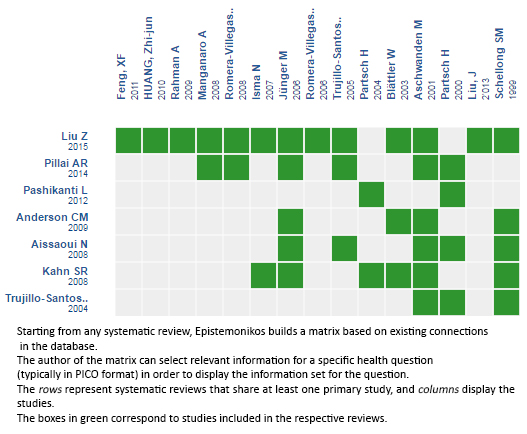
Follow the link to access the interactive version: Early mobilization versus bed rest for deep vein thrombosis
Notes
The upper portion of the matrix of evidence will display a warning of “new evidence” if new systematic reviews are published after the publication of this summary. Even though the project considers the periodical update of these summaries, users are invited to comment in Medwave or to contact the authors through email if they find new evidence and the summary should be updated earlier. After creating an account in Epistemonikos, users will be able to save the matrixes and to receive automated notifications any time new evidence potentially relevant for the question appears.
The details about the methods used to produce these summaries are described here http://dx.doi.org/10.5867/medwave.2014.06.5997.
Epistemonikos foundation is a non-for-profit organization aiming to bring information closer to health decision-makers with technology. Its main development is Epistemonikos database (www.epistemonikos.org).
These summaries follow a rigorous process of internal peer review.
Conflicts of interest
The authors do not have relevant interests to declare.
 Esta obra de Medwave está bajo una licencia Creative Commons Atribución-NoComercial 3.0 Unported. Esta licencia permite el uso, distribución y reproducción del artículo en cualquier medio, siempre y cuando se otorgue el crédito correspondiente al autor del artículo y al medio en que se publica, en este caso, Medwave.

Históricamente el reposo en cama fue incluido como parte del esquema de manejo de pacientes con trombosis venosa profunda con el objetivo de evitar eventos tromboembólicos. Sin embargo, la deambulación precoz podría asociarse a beneficios importantes. Utilizando la base de datos Epistemonikos, la cual es mantenida mediante búsquedas en 30 bases de datos, identificamos siete revisiones sistemáticas que en conjunto incluyen 10 estudios controlados aleatorizados pertinentes. Realizamos un metanálisis y tablas de resumen de los resultados utilizando el método GRADE. Concluimos que la deambulación temprana probablemente disminuye el dolor y el riesgo de progresión de la trombosis, y podría no aumentar el riesgo de tromboembolismo pulmonar.
Authors:
Ariel Izcovich[1,2], Federico Popoff[1,2], Gabriel Rada[3,4,5,6,7]
Affiliation:
[1] Servicio de clínica médica, Hospital Alemán, Buenos Aires, Argentina
[2] Programa de Medicina basada en pruebas, Hospital Alemán, Buenos Aires, Argentina
[3] Programa de Salud Basada en Evidencia, Facultad de Medicina, Pontificia Universidad Católica de Chile, Santiago, Chile
[4] Departamento de Medicina Interna, Facultad de Medicina, Pontificia Universidad Católica de Chile, Santiago, Chile
[5] GRADE working group
[6] The Cochrane Collaboration
[7] Fundación Epistemonikos, Santiago, Chile
E-mail: federicopopoff@gmail.com
Author address:
[1] Hospital Alemán de Buenos Aires
Av. Pueyrredon 1640
CP C118AAT
+54114827700
Citation: Izcovich A, Popoff F, Rada G. Early mobilization versus bed rest for deep vein thrombosis. Medwave 2016;16(Suppl 2):e6478 doi: 10.5867/medwave.2016.6478
Publication date: 28/6/2016
Comments (0)
We are pleased to have your comment on one of our articles. Your comment will be published as soon as it is posted. However, Medwave reserves the right to remove it later if the editors consider your comment to be: offensive in some sense, irrelevant, trivial, contains grammatical mistakes, contains political harangues, appears to be advertising, contains data from a particular person or suggests the need for changes in practice in terms of diagnostic, preventive or therapeutic interventions, if that evidence has not previously been published in a peer-reviewed journal.
No comments on this article.
To comment please log in
Medwave provides HTML and PDF download counts as well as other harvested interaction metrics. There may be a 48-hour delay for most recent metrics to be posted.
- Galanaud JP, Laroche JP, Righini M. The history and historical treatments of deep vein thrombosis. J Thromb Haemost. 2013 Mar;11(3):402-11. | CrossRef | PubMed |
- Aissaoui N, Martins E, Mouly S, Weber S, Meune C. A meta-analysis of bed rest versus early ambulation in the management of pulmonary embolism, deep vein thrombosis, or both. Int J Cardiol. 2009 Sep 11;137(1):37-41. | CrossRef | PubMed |
- Kalisch BJ, Lee S, Dabney BW. Outcomes of inpatient mobilization: a literature review. J Clin Nurs. 2014 Jun;23(11-12):1486-501. | CrossRef | PubMed |
- Anderson CM, Overend TJ, Godwin J, Sealy C, Sunderji A. Ambulation after deep vein thrombosis: a systematic review. Physiother Can. 2009 Summer;61(3):133-40. | CrossRef | PubMed |
- Kahn SR, Shrier I, Kearon C. Physical activity in patients with deep venous thrombosis: a systematic review. Thromb Res. 2008;122(6):763-73. | PubMed |
- Liu Z, Tao X, Chen Y, Fan Z, Li Y. Bed rest versus early ambulation with standard anticoagulation in the management of deep vein thrombosis: a meta-analysis. PLoS One. 2015 Apr 10;10(4):e0121388. | CrossRef | PubMed |
- Pillai AR, Raval JS. Does early ambulation increase the risk of pulmonary embolism in deep vein thrombosis? A review of the literature. Home Healthc Nurse. 2014 Jun;32(6):336-42. | CrossRef | PubMed |
- Trujillo-Santos AJ, Martos-Pérez F, Perea-Milla E. [Bed rest or early mobilization as treatment of deep vein thrombosis: a systematic review and meta-analysis]. Med Clin (Barc). 2004 May 8;122(17):641-7. | PubMed |
- Aschwanden M, Labs KH, Engel H, Schwob A, Jeanneret C, Mueller-Brand J, et al. Acute deep vein thrombosis: early mobilization does not increase the frequency of pulmonary embolism. Thromb Haemost. 2001 Jan;85(1):42-6. | PubMed |
- Romera A C-CM, Pérez-Piqueras A, Martí-Mestre FX, Bonell-Pascual A, Lapiedra-Mur O. La movilización precoz en pacientes con trombosis venosa profunda aguda no aumenta el riesgo de embolismo pulmonar sintomático. ANGIOLOGÍA. 2006;58(2):127-35. | Link |
- Blättler W, Partsch H. Leg compression and ambulation is better than bed rest for the treatment of acute deep venous thrombosis. Int Angiol. 2003 Dec;22(4):393-400. | PubMed |
- Isma N, Johanssson E, Björk A, Björgell O, Robertson F, Mattiasson I,et al. Does supervised exercise after deep venous thrombosis improve recanalization of occluded vein segments? A randomized study. J Thromb Thrombolysis. 2007 Feb;23(1):25-30. | PubMed |
- Jünger M, Diehm C, Störiko H, Hach-Wunderle V, Heidrich H, Karasch T, et al. Mobilization versus immobilization in the treatment of acute proximal deep venous thrombosis: a prospective, randomized, open, multicentre trial. Curr Med Res Opin. 2006 Mar;22(3):593-602. | PubMed |
- Liu, J, Liu, T, Wan, Y, Zou, XM, Liu, QQ. Effect of early functional training on acute deep venous thrombosis of patients with stroke. Chinese Journal of Rehabilitation. 2013;28(2):117-119. | Link |
- Partsch H, Blättler W. Compression and walking versus bed rest in the treatment of proximal deep venous thrombosis with low molecular weight heparin. J Vasc Surg. 2000 Nov;32(5):861-9. | PubMed |
- Partsch H1, Kaulich M, Mayer W. Immediate mobilisation in acute vein thrombosis reduces post-thrombotic syndrome. Int Angiol. 2004 Sep;23(3):206-12. | PubMed |
- Rahman A, Colak MC, Ustünel L, Koc M, Kocakoc E, Colak C. A comparison of different treatment managements in patients with acute deep vein thrombosis by the effects on enhancing venous outflow in the lower limb. Med Sci Monit. 2009 Nov;15(11):CR588-93. | PubMed |
- Romera-Villegas A1, Cairols-Castellote MA, Vila-Coll R, Gómez AP, Martí-Mestre X, Bonell-Pascual A, et al. Early mobilisation in patients with acute deep vein thrombosis does not increase the risk of a symptomatic pulmonary embolism. Int Angiol. 2008 Dec;27(6):494-9. | PubMed |
- Schellong SM, Schwarz T, Kropp J, Prescher Y, Beuthien-Baumann B, Daniel WG. Bed rest in deep vein thrombosis and the incidence of scintigraphic pulmonary embolism. Thromb Haemost. 1999 Sep;82 Suppl 1:127-9. | PubMed |
- Huang ZJ, Qu LF, Jing ZP, Liu AF, Yuan XL. A randomized controlled prospective study on ambulation versus bed rest for the initial treatment of patients with acute deep venous thrombosis. Chin J Gen Surg. 2010(9 ):737-739. | CrossRef |
- Manganaro A, Ando G, Lembo D, Sutera Sardo L, Buda D. A retrospective analysis of hospitalized patients with documented deep-venous thrombosis and their risk of pulmonary embolism. Angiology. 2008 Oct-Nov;59(5):599-604. | CrossRef | PubMed |
- Trujillo-Santos J, Perea-Milla E, Jiménez-Puente A, Sánchez-Cantalejo E, del Toro J, Grau E, et al. Bed rest or ambulation in the initial treatment of patients with acute deep vein thrombosis or pulmonary embolism: findings from the RIETE registry. Chest. 2005 May;127(5):1631-6. | PubMed |
- Feng. Early walking for treatment of acute deep vein thrombosis. Gems of Health. 2011;8:74,51. | Link |
- Landorf KB, Radford JA, Hudson S. Minimal Important Difference (MID) of two commonly used outcome measures for foot problems. J Foot Ankle Res. 2010 May 14;3:7. | CrossRef | PubMed |
- Lee JS, Hobden E, Stiell IG, Wells GA. Clinically important change in the visual analog scale after adequate pain control. Acad Emerg Med. 2003 Oct;10(10):1128-30. | PubMed |
- Stauffer ME, Taylor SD, Watson DJ, Peloso PM, Morrison A. Definition of nonresponse to analgesic treatment of arthritic pain: an analytical literature review of the smallest detectable difference, the minimal detectable change, and the minimal clinically important difference on the pain visual analog scale. Int J Inflam. 2011;2011:231926. | CrossRef | PubMed |
- Guyatt GH, Oxman AD, Kunz R, Brozek J, Alonso-Coello P, Rind D, et al. GRADE guidelines 6. Rating the quality of evidence--imprecision. J Clin Epidemiol. 2011 Dec;64(12):1283-93. | CrossRef | PubMed |
- Brajesh K. Lal M. Role of a Novel Exercise Program to Prevent Post-thrombotic Syndrome (EFFORT2). clinicaltrials.gov. [on line]. | Link |
Galanaud JP, Laroche JP, Righini M. The history and historical treatments of deep vein thrombosis. J Thromb Haemost. 2013 Mar;11(3):402-11. | CrossRef | PubMed |Aissaoui N, Martins E, Mouly S, Weber S, Meune C. A meta-analysis of bed rest versus early ambulation in the management of pulmonary embolism, deep vein thrombosis, or both. Int J Cardiol. 2009 Sep 11;137(1):37-41. | CrossRef | PubMed |Kalisch BJ, Lee S, Dabney BW. Outcomes of inpatient mobilization: a literature review. J Clin Nurs. 2014 Jun;23(11-12):1486-501. | CrossRef | PubMed |Anderson CM, Overend TJ, Godwin J, Sealy C, Sunderji A. Ambulation after deep vein thrombosis: a systematic review. Physiother Can. 2009 Summer;61(3):133-40. | CrossRef | PubMed |Kahn SR, Shrier I, Kearon C. Physical activity in patients with deep venous thrombosis: a systematic review. Thromb Res. 2008;122(6):763-73. | PubMed |Liu Z, Tao X, Chen Y, Fan Z, Li Y. Bed rest versus early ambulation with standard anticoagulation in the management of deep vein thrombosis: a meta-analysis. PLoS One. 2015 Apr 10;10(4):e0121388. | CrossRef | PubMed |Pillai AR, Raval JS. Does early ambulation increase the risk of pulmonary embolism in deep vein thrombosis? A review of the literature. Home Healthc Nurse. 2014 Jun;32(6):336-42. | CrossRef | PubMed |Trujillo-Santos AJ, Martos-Pérez F, Perea-Milla E. [Bed rest or early mobilization as treatment of deep vein thrombosis: a systematic review and meta-analysis]. Med Clin (Barc). 2004 May 8;122(17):641-7. | PubMed |Aschwanden M, Labs KH, Engel H, Schwob A, Jeanneret C, Mueller-Brand J, et al. Acute deep vein thrombosis: early mobilization does not increase the frequency of pulmonary embolism. Thromb Haemost. 2001 Jan;85(1):42-6. | PubMed |Romera A C-CM, Pérez-Piqueras A, Martí-Mestre FX, Bonell-Pascual A, Lapiedra-Mur O. La movilización precoz en pacientes con trombosis venosa profunda aguda no aumenta el riesgo de embolismo pulmonar sintomático. ANGIOLOGÍA. 2006;58(2):127-35. | Link |Blättler W, Partsch H. Leg compression and ambulation is better than bed rest for the treatment of acute deep venous thrombosis. Int Angiol. 2003 Dec;22(4):393-400. | PubMed |Isma N, Johanssson E, Björk A, Björgell O, Robertson F, Mattiasson I,et al. Does supervised exercise after deep venous thrombosis improve recanalization of occluded vein segments? A randomized study. J Thromb Thrombolysis. 2007 Feb;23(1):25-30. | PubMed |Jünger M, Diehm C, Störiko H, Hach-Wunderle V, Heidrich H, Karasch T, et al. Mobilization versus immobilization in the treatment of acute proximal deep venous thrombosis: a prospective, randomized, open, multicentre trial. Curr Med Res Opin. 2006 Mar;22(3):593-602. | PubMed |Liu, J, Liu, T, Wan, Y, Zou, XM, Liu, QQ. Effect of early functional training on acute deep venous thrombosis of patients with stroke. Chinese Journal of Rehabilitation. 2013;28(2):117-119. | Link |Partsch H, Blättler W. Compression and walking versus bed rest in the treatment of proximal deep venous thrombosis with low molecular weight heparin. J Vasc Surg. 2000 Nov;32(5):861-9. | PubMed |Partsch H1, Kaulich M, Mayer W. Immediate mobilisation in acute vein thrombosis reduces post-thrombotic syndrome. Int Angiol. 2004 Sep;23(3):206-12. | PubMed |Rahman A, Colak MC, Ustünel L, Koc M, Kocakoc E, Colak C. A comparison of different treatment managements in patients with acute deep vein thrombosis by the effects on enhancing venous outflow in the lower limb. Med Sci Monit. 2009 Nov;15(11):CR588-93. | PubMed |Romera-Villegas A1, Cairols-Castellote MA, Vila-Coll R, Gómez AP, Martí-Mestre X, Bonell-Pascual A, et al. Early mobilisation in patients with acute deep vein thrombosis does not increase the risk of a symptomatic pulmonary embolism. Int Angiol. 2008 Dec;27(6):494-9. | PubMed |Schellong SM, Schwarz T, Kropp J, Prescher Y, Beuthien-Baumann B, Daniel WG. Bed rest in deep vein thrombosis and the incidence of scintigraphic pulmonary embolism. Thromb Haemost. 1999 Sep;82 Suppl 1:127-9. | PubMed |Huang ZJ, Qu LF, Jing ZP, Liu AF, Yuan XL. A randomized controlled prospective study on ambulation versus bed rest for the initial treatment of patients with acute deep venous thrombosis. Chin J Gen Surg. 2010(9 ):737-739. | CrossRef |Manganaro A, Ando G, Lembo D, Sutera Sardo L, Buda D. A retrospective analysis of hospitalized patients with documented deep-venous thrombosis and their risk of pulmonary embolism. Angiology. 2008 Oct-Nov;59(5):599-604. | CrossRef | PubMed |Trujillo-Santos J, Perea-Milla E, Jiménez-Puente A, Sánchez-Cantalejo E, del Toro J, Grau E, et al. Bed rest or ambulation in the initial treatment of patients with acute deep vein thrombosis or pulmonary embolism: findings from the RIETE registry. Chest. 2005 May;127(5):1631-6. | PubMed |Feng. Early walking for treatment of acute deep vein thrombosis. Gems of Health. 2011;8:74,51. | Link |Landorf KB, Radford JA, Hudson S. Minimal Important Difference (MID) of two commonly used outcome measures for foot problems. J Foot Ankle Res. 2010 May 14;3:7. | CrossRef | PubMed |Lee JS, Hobden E, Stiell IG, Wells GA. Clinically important change in the visual analog scale after adequate pain control. Acad Emerg Med. 2003 Oct;10(10):1128-30. | PubMed |Stauffer ME, Taylor SD, Watson DJ, Peloso PM, Morrison A. Definition of nonresponse to analgesic treatment of arthritic pain: an analytical literature review of the smallest detectable difference, the minimal detectable change, and the minimal clinically important difference on the pain visual analog scale. Int J Inflam. 2011;2011:231926. | CrossRef | PubMed |Guyatt GH, Oxman AD, Kunz R, Brozek J, Alonso-Coello P, Rind D, et al. GRADE guidelines 6. Rating the quality of evidence--imprecision. J Clin Epidemiol. 2011 Dec;64(12):1283-93. | CrossRef | PubMed |Brajesh K. Lal M. Role of a Novel Exercise Program to Prevent Post-thrombotic Syndrome (EFFORT2). clinicaltrials.gov. [on line]. | Link |





 Research papers
Systematization of initiatives in sexual and reproductive health about good practices criteria in response to the COVID-19 pandemic in primary health care in Chile
Clinical, psychological, social, and family characterization of suicidal behavior in Chilean adolescents: a multiple correspondence analysis
