

Abstract
Central venous catheter-related blood stream infection is a major cause of morbidity and mortality in patients with renal disease treated with hemodialysis. Antibiotic lock solutions can be effective in preventing this complication in patients with hemodialysis. Searching in Epistemonikos database, which is maintained by screening more than twenty databases, we identified eight systematic reviews including seventeen randomized trials. We combined the evidence using meta-analysis and generated a summary of findings table following the GRADE approach. We concluded that antibiotic lock solutions probably decrease catheter-related blood stream infection in hemodialysis patients.
Problem
Central venous catheter-related blood stream infections can lead to serious infectious complications in patients with renal disease treated with hemodialysis, such as infective endocarditis, septic pulmonary emboli, osteomyelitis and abscesses as a result of hematogenous seeding.
Despite the risks associated to this type of vascular access, many times it is the only option because of temporary loss of permanent hemodialysis access, peripheral vascular disease or as transitory alternative while waiting for the maturation of arteriovenous fistula. Intraluminal antibiotic lock solutions that are maintained for a specified time before being removed can be useful for decreasing the risk of central venous catheter-related blood stream infections.
Methods
We used Epistemonikos database, which is maintained by screening more than 20 databases, to identify systematic reviews and their included primary studies.
With this information we generated a structured summary using a pre-established format, which includes key messages, a summary of the body of evidence (presented as an evidence matrix in Epistemonikos), meta-analysis of the total of studies, a summary of findings table following the GRADE approach and a table of other considerations for decision-making.
|
Key messages
|
About the body of evidence for this question
|
What is the evidence |
We found 8 systematic reviews [1],[2],[3],[4],[5],[6],[7],[8] |
|
What types of patients were included |
The trials included patients with no distinction by sex or age. All of the trials included hemodialysis patients, using tunneled (11 trials), non-tunneled (4 trials) or both types of catheters (2 trials). The randomized trials included 1921 adult patients. |
|
What types of interventions were included |
The studies employed different kind of antibiotics as lock therapy (vancomycin, gentamicin, minocicline, cefotaxime, cefazoline and linezolid; associated to heparin, tricitasol, citrate or etildiaminotetraacetic acid). All trials compared against heparin in the control group. |
|
What types of outcomes were measured |
Bacteremia/ central venous catheter-related blood stream infection, time until infection, exit-site infection, catheter-associated mortality, total mortality. |
Summary of findings
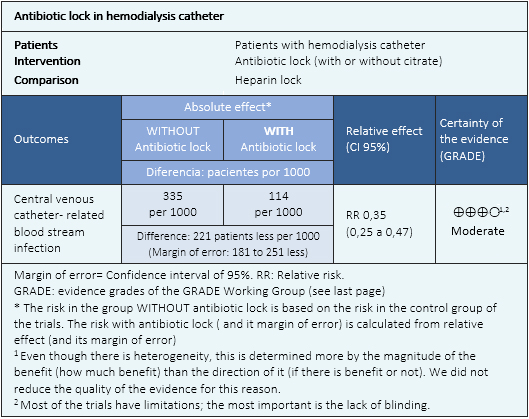
This information is based on 17 randomized trials. All of them reported central venous catheter-related blood stream infection.
- Antibiotic lock solutions probably decrease catheter-related blood stream infection in hemodialysis patients.
Other considerations for decision-making
|
To whom this evidence does and does not apply |
|
| About the outcomes included in this summary |
|
|
Balance between benefits and risks, and certainty of the evidence |
|
| What do patients and their doctors think about |
|
|
Resource considerations |
|
|
Feasibility and implementation |
|
|
Differences between this summary and other sources |
|
|
Could this evidence change in the future? |
|
How we conducted this summary
Using automated and collaborative means we compiled all the relevant evidence for the question of interest and we present a matrix of evidence
Follow the link to access the interactive version: Antibiotic lock therapy for prevention of central venous catheter-related blood stream infection in hemodialysis

Notes
The upper portion of the matrix of evidence will display a warning of “new evidence” if new systematic reviews are published after the publication of this summary.
Even though the project considers the periodical update of these summaries, users are invited to comment in the website of Medwave or to contact the authors through email if they realize there is new evidence and the summary should be updated earlier.
After creating an account in Epistemonikos, users will be able to save the matrixes and to receive automated notifications any time new evidence potentially relevant for the question appears.
The details about the methods used to produce this summaries are described here http://dx.doi.org/10.5867/medwave.2014.06.5997.
Epistemonikos foundation is a non-for-profit organisation aiming to bring information closer to those making health decisions, through the use of technology. Its main development is Epistemonikos database (www.epistemonikos.org).
These summaries follow a rigorous process of internal peer review.
Follow the link to access the interactive version Antibiotic lock therapy for prevention of central venous catheter-related blood stream infection in hemodialysis

 Matrix of evidence
 Esta obra de Medwave está bajo una licencia Creative Commons Atribución-NoComercial 3.0 Unported. Esta licencia permite el uso, distribución y reproducción del artículo en cualquier medio, siempre y cuando se otorgue el crédito correspondiente al autor del artículo y al medio en que se publica, en este caso, Medwave.
Las infecciones del torrente sanguíneo asociadas a catéteres venosos centrales son una de las principales complicaciones de su uso, lo cual conlleva a un aumento de morbimortalidad en pacientes con insuficiencia renal en hemodiálisis. El uso de soluciones de sellado con antibióticos podría ser efectivo para prevenir esta complicación. Utilizando la base de datos Epistemonikos, la cual es mantenida mediante búsquedas en más de veinte bases de datos, identificamos ocho revisiones sistemáticas que en conjunto incluyen diecisiete estudios aleatorizados. Realizamos un metanálisis y tablas de resumen de los resultados utilizando el método GRADE. Concluimos que el uso de soluciones de sellado con antibióticos probablemente disminuye el número de infecciones del torrente sanguíneo asociadas a catéteres venosos centrales en pacientes en hemodiálisis.
Authors:
Macarena Jiménez[1], Trinidad Madrid[1]
Affiliation:
[1] Departamento de Medicina Interna, Facultad de Medicina, Pontificia Universidad Católica de Chile, Santiago, Chile
E-mail: mtmadrid@uc.cl
Author address:
[1] Departamento de Medicina Interna, Facultad de Medicina, Pontificia Universidad Católica de Chile, Santiago, Chile
Citation: Jiménez M, Madrid T. Does antibiotic lock therapy prevent catheter-associated bacteremia in hemodialysis?. Medwave 2014 Ene;15(1):e6069 doi: 10.5867/medwave.2015.01.6069
Publication date: 22/1/2015
Comments (0)
We are pleased to have your comment on one of our articles. Your comment will be published as soon as it is posted. However, Medwave reserves the right to remove it later if the editors consider your comment to be: offensive in some sense, irrelevant, trivial, contains grammatical mistakes, contains political harangues, appears to be advertising, contains data from a particular person or suggests the need for changes in practice in terms of diagnostic, preventive or therapeutic interventions, if that evidence has not previously been published in a peer-reviewed journal.
No comments on this article.
To comment please log in
Medwave provides HTML and PDF download counts as well as other harvested interaction metrics. There may be a 48-hour delay for most recent metrics to be posted.
- Jaffer Y, Selby NM, Taal MW, Fluck RJ, McIntyre CW. A meta-analysis of hemodialysis catheter locking solutions in the prevention of catheter-related infection. Am J Kidney Dis. 2008 Feb;51(2):233-41. | CrossRef | PubMed |
- James MT, Conley J, Tonelli M, Manns BJ, MacRae J, Hemmelgarn BR. Meta-analysis: antibiotics for prophylaxis against hemodialysis catheter-related infections. Ann Intern Med. 2008 Apr 15;148(8):596-605. | CrossRef | PubMed |
- Labriola L, Crott R, Jadoul M. Preventing haemodialysis catheter-related bacteraemia with an antimicrobial lock solution: a meta-analysis of prospective randomized trials. Nephrol Dial Transplant. 2008 May;23(5):1666-72. | CrossRef | PubMed |
- Rabindranath KS, Bansal T, Adams J, Das R, Shail R, MacLeod AM, et al. Systematic review of antimicrobials for the prevention of haemodialysis catheter-related infections. Nephrol Dial Transplant. 2009 Dec;24(12):3763-74. | CrossRef | PubMed |
- Snaterse M1, Rüger W, Scholte Op Reimer WJ, Lucas C. Antibiotic-based catheter lock solutions for prevention of catheter-related bloodstream infection: a systematic review of randomised controlled trials. J Hosp Infect. 2010 May;75(1):1-11. | CrossRef | PubMed |
- Wang AY, Ivany JN, Perkovic V, Gallagher MP, Jardine MJ. Anticoagulant therapies for the prevention of intravascular catheters malfunction in patients undergoing haemodialysis: systematic review and meta-analysis of randomized, controlled trials. Nephrol Dial Transplant. 2013 Nov;28(11):2875-88. | CrossRef | PubMed |
- Yahav D, Rozen-Zvi B, Gafter-Gvili A, Leibovici L, Gafter U, Paul M. Antimicrobial lock solutions for the prevention of infections associated with intravascular catheters in patients undergoing hemodialysis: systematic review and meta-analysis of randomized, controlled trials. Clin Infect Dis. 2008 Jul 1;47(1):83-93. | CrossRef | PubMed |
- Zacharioudakis IM, Zervou FN1, Arvanitis M1, Ziakas PD1, Mermel LA1, Mylonakis E1. Antimicrobial lock solutions as a method to prevent central line-associated bloodstream infections: a meta-analysis of randomized controlled trials. Clin Infect Dis. 2014 Dec 15;59(12):1741-9. | CrossRef | PubMed |
- Al-Hwiesh AK, Abdul-Rahman IS. Successful prevention of tunneled, central catheter infection by antibiotic lock therapy using vancomycin and gentamycin. Saudi J Kidney Dis Transpl. 2007 Jun;18(2):239-47. | PubMed |
- Bleyer AJ, Mason L, Russell G, Raad II, Sherertz RJ. A randomized, controlled trial of a new vascular catheter flush solution (minocycline-EDTA) in temporary hemodialysis access. Infect Control Hosp Epidemiol. 2005 Jun;26(6):520-4. | PubMed |
- Campos RP, do Nascimento MM, Chula DC, Riella MC. Minocycline-EDTA lock solution prevents catheter-related bacteremia in hemodialysis. J Am Soc Nephrol. 2011 Oct;22(10):1939-45. | CrossRef | PubMed |
- Cooper RI, Saad TF. Prevention of bacteremia in patients with tunneled cuffed "permanent" hemodialysis catheters (PCs) using gentamicin catheter packing. J Am Soc Nephrol. 1999;10:203A.
- Dogra GK, Herson H, Hutchison B, Irish AB, Heath CH, Golledge C, et al. Prevention of tunneled hemodialysis catheter-related infections using catheter-restricted filling with gentamicin and citrate: a randomized controlled study. J Am Soc Nephrol. 2002 Aug;13(8):2133-9. | CrossRef | PubMed |
- Filiopoulos V, Hadjiyannakos D, Koutis I, Trompouki S, Micha T, Lazarou D, Vlassopoulos D. Approaches to prolong the use of uncuffed hemodialysis catheters: results of a randomized trial. Am J Nephrol. 2011;33(3):260-8. | CrossRef | PubMed |
- Kim SH, Song KI, Chang JW, Kim SB, Sung SA, Jo SK, et al. Prevention of uncuffed hemodialysis catheter-related bacteremia using an antibiotic lock technique: a prospective, randomized clinical trial. Kidney Int. 2006 Jan;69(1):161-4. | CrossRef | PubMed |
- McIntyre CW, Hulme LJ, Taal M, Fluck RJ. Locking of tunneled hemodialysis catheters with gentamicin and heparin. Kidney Int. 2004 Aug;66(2):801-5. | CrossRef | PubMed |
- Moran J, Sun S, Khababa I, Pedan A, Doss S, Schiller B. A randomized trial comparing gentamicin/citrate and heparin locks for central venous catheters in maintenance hemodialysis patients. Am J Kidney Dis. 2012 Jan;59(1):102-7. | CrossRef | PubMed |
- Nori US, Manoharan A, Yee J, Besarab A. Comparison of low-dose gentamicin with minocycline as catheter lock solutions in the prevention of catheter-related bacteremia. Am J Kidney Dis. 2006 Oct;48(4):596-605. | CrossRef | PubMed |
- Pervez A, Ahmed M, Ram S, Torres C, Work J, Zaman F, et al. Antibiotic lock technique for prevention of cuffed tunnel catheter associated bacteremia. J Vasc Access. 2002 Jul-Sep;3(3):108-13. | CrossRef |
- Saxena AK, Panhotra BR. The impact of catheter-restricted filling with cefotaxime and heparin on the lifespan of temporary hemodialysis catheters: a case controlled study. J Nephrol. 2005 Nov-Dec;18(6):755-63. | PubMed |
- Saxena AK, Panhotra BR, Sundaram DS, Al-Hafiz A, Naguib M, Venkateshappa CK, et al. Tunneled catheters' outcome optimization among diabetics on dialysis through antibiotic-lock placement. Kidney Int. 2006 Nov;70(9):1629-35. | CrossRef | PubMed |
- Saxena AK, Panhotra BR, Sundaram DS, Morsy MN, Al-Ghamdi AM. Enhancing the survival of tunneled haemodialysis catheters using an antibiotic lock in the elderly: a randomised, double-blind clinical trial. Nephrology (Carlton). 2006 Aug;11(4):299-305. | CrossRef | PubMed |
- Sofroniadou S, Revela I, Smirloglou D, Makriniotou I, Zerbala S, Kouloubinis A, et al. Linezolid versus vancomycin antibiotic lock solution for the prevention of nontunneled catheter-related blood stream infections in hemodialysis patients: a prospective randomized study. Semin Dial. 2012 May;25(3):344-50. | CrossRef | PubMed |
- Zhang P, Yuan J, Tan H, Lv R, Chen J. Successful prevention of cuffed hemodialysis catheter-related infection using an antibiotic lock technique by strictly catheter-restricted antibiotic lock solution method. Blood Purif. 2009;27(2):206-11. | CrossRef | PubMed |
- Zhang P, Zhang W, Qiang H, Yuan J, Xie W, Jiang H. A randomized controlled study on prevention of cuff-tunneled catheter related bacteremia with gentamicin-heparin lock solution. Renal Week, San Diego; 2006: 592A.
- O'Grady NP, Alexander M, Burns LA, Dellinger EP, Garland J, Heard SO, et al. Guidelines for the prevention of intravascular catheter-related infections. Clin Infect Dis. 2011 May;52(9):e162-93. | CrossRef | PubMed |
Jaffer Y, Selby NM, Taal MW, Fluck RJ, McIntyre CW. A meta-analysis of hemodialysis catheter locking solutions in the prevention of catheter-related infection. Am J Kidney Dis. 2008 Feb;51(2):233-41. | CrossRef | PubMed |James MT, Conley J, Tonelli M, Manns BJ, MacRae J, Hemmelgarn BR. Meta-analysis: antibiotics for prophylaxis against hemodialysis catheter-related infections. Ann Intern Med. 2008 Apr 15;148(8):596-605. | CrossRef | PubMed |Labriola L, Crott R, Jadoul M. Preventing haemodialysis catheter-related bacteraemia with an antimicrobial lock solution: a meta-analysis of prospective randomized trials. Nephrol Dial Transplant. 2008 May;23(5):1666-72. | CrossRef | PubMed |Rabindranath KS, Bansal T, Adams J, Das R, Shail R, MacLeod AM, et al. Systematic review of antimicrobials for the prevention of haemodialysis catheter-related infections. Nephrol Dial Transplant. 2009 Dec;24(12):3763-74. | CrossRef | PubMed |Snaterse M1, Rüger W, Scholte Op Reimer WJ, Lucas C. Antibiotic-based catheter lock solutions for prevention of catheter-related bloodstream infection: a systematic review of randomised controlled trials. J Hosp Infect. 2010 May;75(1):1-11. | CrossRef | PubMed | Wang AY, Ivany JN, Perkovic V, Gallagher MP, Jardine MJ. Anticoagulant therapies for the prevention of intravascular catheters malfunction in patients undergoing haemodialysis: systematic review and meta-analysis of randomized, controlled trials. Nephrol Dial Transplant. 2013 Nov;28(11):2875-88. | CrossRef | PubMed |Yahav D, Rozen-Zvi B, Gafter-Gvili A, Leibovici L, Gafter U, Paul M. Antimicrobial lock solutions for the prevention of infections associated with intravascular catheters in patients undergoing hemodialysis: systematic review and meta-analysis of randomized, controlled trials. Clin Infect Dis. 2008 Jul 1;47(1):83-93. | CrossRef | PubMed |Zacharioudakis IM, Zervou FN1, Arvanitis M1, Ziakas PD1, Mermel LA1, Mylonakis E1. Antimicrobial lock solutions as a method to prevent central line-associated bloodstream infections: a meta-analysis of randomized controlled trials. Clin Infect Dis. 2014 Dec 15;59(12):1741-9. | CrossRef | PubMed |Al-Hwiesh AK, Abdul-Rahman IS. Successful prevention of tunneled, central catheter infection by antibiotic lock therapy using vancomycin and gentamycin. Saudi J Kidney Dis Transpl. 2007 Jun;18(2):239-47. | PubMed |Bleyer AJ, Mason L, Russell G, Raad II, Sherertz RJ. A randomized, controlled trial of a new vascular catheter flush solution (minocycline-EDTA) in temporary hemodialysis access. Infect Control Hosp Epidemiol. 2005 Jun;26(6):520-4. | PubMed |Campos RP, do Nascimento MM, Chula DC, Riella MC. Minocycline-EDTA lock solution prevents catheter-related bacteremia in hemodialysis. J Am Soc Nephrol. 2011 Oct;22(10):1939-45. | CrossRef | PubMed |Cooper RI, Saad TF. Prevention of bacteremia in patients with tunneled cuffed "permanent" hemodialysis catheters (PCs) using gentamicin catheter packing. J Am Soc Nephrol. 1999;10:203A. Dogra GK, Herson H, Hutchison B, Irish AB, Heath CH, Golledge C, et al. Prevention of tunneled hemodialysis catheter-related infections using catheter-restricted filling with gentamicin and citrate: a randomized controlled study. J Am Soc Nephrol. 2002 Aug;13(8):2133-9. | CrossRef | PubMed |Filiopoulos V, Hadjiyannakos D, Koutis I, Trompouki S, Micha T, Lazarou D, Vlassopoulos D. Approaches to prolong the use of uncuffed hemodialysis catheters: results of a randomized trial. Am J Nephrol. 2011;33(3):260-8. | CrossRef | PubMed |Kim SH, Song KI, Chang JW, Kim SB, Sung SA, Jo SK, et al. Prevention of uncuffed hemodialysis catheter-related bacteremia using an antibiotic lock technique: a prospective, randomized clinical trial. Kidney Int. 2006 Jan;69(1):161-4. | CrossRef | PubMed |McIntyre CW, Hulme LJ, Taal M, Fluck RJ. Locking of tunneled hemodialysis catheters with gentamicin and heparin. Kidney Int. 2004 Aug;66(2):801-5. | CrossRef | PubMed |Moran J, Sun S, Khababa I, Pedan A, Doss S, Schiller B. A randomized trial comparing gentamicin/citrate and heparin locks for central venous catheters in maintenance hemodialysis patients. Am J Kidney Dis. 2012 Jan;59(1):102-7. | CrossRef | PubMed |Nori US, Manoharan A, Yee J, Besarab A. Comparison of low-dose gentamicin with minocycline as catheter lock solutions in the prevention of catheter-related bacteremia. Am J Kidney Dis. 2006 Oct;48(4):596-605. | CrossRef | PubMed |Pervez A, Ahmed M, Ram S, Torres C, Work J, Zaman F, et al. Antibiotic lock technique for prevention of cuffed tunnel catheter associated bacteremia. J Vasc Access. 2002 Jul-Sep;3(3):108-13. | CrossRef |Saxena AK, Panhotra BR. The impact of catheter-restricted filling with cefotaxime and heparin on the lifespan of temporary hemodialysis catheters: a case controlled study. J Nephrol. 2005 Nov-Dec;18(6):755-63. | PubMed |Saxena AK, Panhotra BR, Sundaram DS, Al-Hafiz A, Naguib M, Venkateshappa CK, et al. Tunneled catheters' outcome optimization among diabetics on dialysis through antibiotic-lock placement. Kidney Int. 2006 Nov;70(9):1629-35. | CrossRef | PubMed |Saxena AK, Panhotra BR, Sundaram DS, Morsy MN, Al-Ghamdi AM. Enhancing the survival of tunneled haemodialysis catheters using an antibiotic lock in the elderly: a randomised, double-blind clinical trial. Nephrology (Carlton). 2006 Aug;11(4):299-305. | CrossRef | PubMed |Sofroniadou S, Revela I, Smirloglou D, Makriniotou I, Zerbala S, Kouloubinis A, et al. Linezolid versus vancomycin antibiotic lock solution for the prevention of nontunneled catheter-related blood stream infections in hemodialysis patients: a prospective randomized study. Semin Dial. 2012 May;25(3):344-50. | CrossRef | PubMed |Zhang P, Yuan J, Tan H, Lv R, Chen J. Successful prevention of cuffed hemodialysis catheter-related infection using an antibiotic lock technique by strictly catheter-restricted antibiotic lock solution method. Blood Purif. 2009;27(2):206-11. | CrossRef | PubMed |Zhang P, Zhang W, Qiang H, Yuan J, Xie W, Jiang H. A randomized controlled study on prevention of cuff-tunneled catheter related bacteremia with gentamicin-heparin lock solution. Renal Week, San Diego; 2006: 592A. 





 Research papers
Systematization of initiatives in sexual and reproductive health about good practices criteria in response to the COVID-19 pandemic in primary health care in Chile
Clinical, psychological, social, and family characterization of suicidal behavior in Chilean adolescents: a multiple correspondence analysis
