
Revista Biomédica Revisada Por Pares

 Para Descargar PDF debe Abrir sesión.
Ménière’s disease affects the inner ear and its main symptoms are vertigo, hearing loss and fluctuating aural symptoms. Nowadays, there are many therapeutic alternatives, being the use of intratympanic corticosteroids one that has become popular. To answer this question, we searched in Epistemonikos database, which is maintained by screening multiple databases. We identified four systematic reviews including 15 studies overall, of which seven were randomized trials. We extracted data and generated a summary of findings table using the GRADE approach. We concluded intratympanic corticosteroids probably do not decrease tinnitus, and might not decrease vertigo, hearing loss or aural fullness sensation in Ménière’s disease. Intratympanic corticosteroids probably do not cause important adverse effects.
Ménière’s disease affects the inner ear and it is characterized by episodes of recurrent vertigo, fluctuating sensorineural hearing loss and aural symptoms (such as tinnitus and aural fullness), being its main characteristic the fluctuation of its symptoms [1],[2]. The objective of the treatment is to reduce the intensity of the cardinal symptoms, to decrease the number of acute vertigo crises and to prevent the progression of the disease. Nowadays there are many therapeutic alternatives, including dietary sodium restriction, antivertiginous drugs, diuretics, intratympanic injection of drugs and even surgery. There is no consensus regarding the best intervention, nonetheless, one of the alternatives that has gained popularity in the last years is the injection of intratympanic corticosteroids [1].
Ménière’s disease is supposed to be an immunological disorder of the endolymphatic sac, with mechanisms involved at many levels. In this way, the injection of corticosteroids would have a role when absorbed towards the perilymph [1]. Its advantage would be achieving a higher concentration of corticosteroids in the inner ear, and avoiding adverse effects associated to systemic use. Also, it is a procedure that can be performed in an ambulatory setting [1]. However, there is a low risk of persistent tympanic perforation, dysgeusia, vertigo and pain; the latter two are generally self-limited [3].
We used Epistemonikos database, which is maintained by screening multiple databases, to identify systematic reviews and their included primary studies. With this information we generated a structured summary using a pre-established format, which includes key messages, a summary of the body of evidence (presented as an evidence matrix in Epistemonikos), meta-analysis of the total of studies, a summary of findings table following the GRADE approach and a table of other considerations for decision-making.
|
Key messages
|
|
What is the evidence. |
We found four systematic reviews [1],[4],[5],[6] that include 15 primary studies reported in 17 references [7], [8],[9],[10],[11],[12],[13],[14],[15],[16],[17],[18],[19], [20],[21], among them seven randomized controlled trials [7],[8],[10],[11],[12],[13],[14], from which four compare the intervention against placebo or no treatment, which correspond to the question of this summary [7],[8],[12],[13]. This table and the summary in general are based on the latter. |
|
What types of patients were included |
The four trials included patients with the diagnosis of Ménière’s disease with failure to medical treatment. The diagnostic criteria of the American Academy of Otolaryngology-Head and Neck Surgery (AAO-HNS) for the diagnosis of definite Ménière’s disease were used in two trials [8],[12]. None of the systematic reviews specified the criterion used for the remaining two trials [7],[12]. |
|
What types of interventions were included |
The trials assessed intratympanic injection of dexamethasone in different protocols:
Three trials compared against intratympanic injection of placebo [7],[8],[12] and one against medical treatment [13]. |
|
What types of outcomes |
The outcomes where grouped as follows:
|
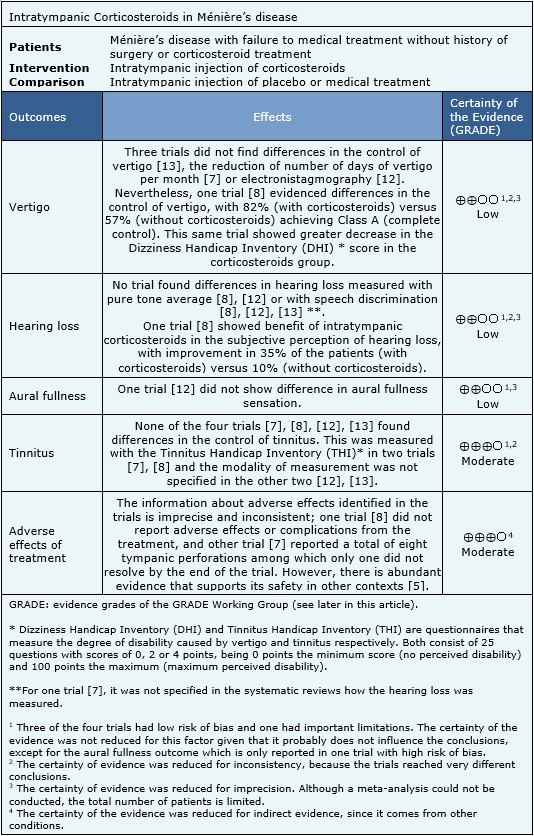
The information regarding the effects of intratympanic corticosteroids in Ménière’s disease is based on four randomized trials that include 126 patients [7],[8], [12],[13]. All of the trials reported vertigo, hearing loss and tinnitus. Aural fullness was reported only by one trial [13] and the adverse effects were reported in two trials [7],[8].
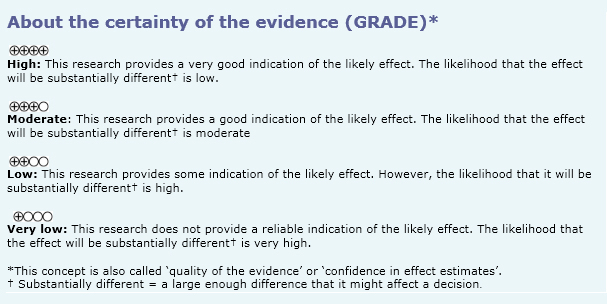
The summary of findings is the following:
|
To whom this evidence does and does not apply |
|
| About the outcomes included in this summary |
|
| Balance between benefits and risks, and certainty of the evidence |
|
| What would patients and their doctors think about this intervention |
|
| Resource considerations |
|
|
Differences between this summary and other sources |
|
| Could this evidence change in the future? |
|
Using automated and collaborative means, we compiled all the relevant evidence for the question of interest and we present it as a matrix of evidence.
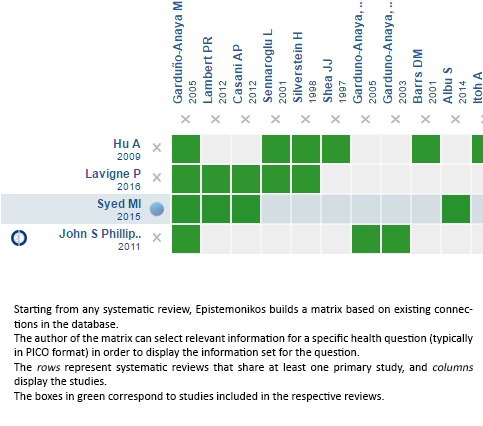
Follow the link to access the interactive version: Intratympanic steroids for Ménière's disease
The upper portion of the matrix of evidence will display a warning of “new evidence” if new systematic reviews are published after the publication of this summary. Even though the project considers the periodical update of these summaries, users are invited to comment in Medwave or to contact the authors through email if they find new evidence and the summary should be updated earlier. After creating an account in Epistemonikos, users will be able to save the matrixes and to receive automated notifications any time new evidence potentially relevant for the question appears.
The details about the methods used to produce these summaries are described here http://dx.doi.org/10.5867/medwave.2014.06.5997.
Epistemonikos foundation is a non-for-profit organization aiming to bring information closer to health decision-makers with technology. Its main development is Epistemonikos database (www.epistemonikos.org).
These summaries follow a rigorous process of internal peer review.
Conflicts of interest
The authors do not have relevant interests to declare.
 Esta obra de Medwave está bajo una licencia Creative Commons Atribución-NoComercial 3.0 Unported. Esta licencia permite el uso, distribución y reproducción del artículo en cualquier medio, siempre y cuando se otorgue el crédito correspondiente al autor del artículo y al medio en que se publica, en este caso, Medwave.
Ménière’s disease affects the inner ear and its main symptoms are vertigo, hearing loss and fluctuating aural symptoms. Nowadays, there are many therapeutic alternatives, being the use of intratympanic corticosteroids one that has become popular. To answer this question, we searched in Epistemonikos database, which is maintained by screening multiple databases. We identified four systematic reviews including 15 studies overall, of which seven were randomized trials. We extracted data and generated a summary of findings table using the GRADE approach. We concluded intratympanic corticosteroids probably do not decrease tinnitus, and might not decrease vertigo, hearing loss or aural fullness sensation in Ménière’s disease. Intratympanic corticosteroids probably do not cause important adverse effects.
Autores:
Ángela Chuang-Chuang[1,2], María A Baeza[2,3]
Citación: Chuang-Chuang A, Baeza M. Are intratympanic corticosteroids effective for Ménière’s disease?. Medwave 2017; 17(Suppl1):e6863 doi: 10.5867/medwave.2017.6863
Fecha de envío: 23/12/2016
Fecha de aceptación: 23/12/2016
Fecha de publicación: 13/3/2017
Nos complace que usted tenga interés en comentar uno de nuestros artículos. Su comentario será publicado inmediatamente. No obstante, Medwave se reserva el derecho a eliminarlo posteriormente si la dirección editorial considera que su comentario es: ofensivo en algún sentido, irrelevante, trivial, contiene errores de lenguaje, contiene arengas políticas, obedece a fines comerciales, contiene datos de alguna persona en particular, o sugiere cambios en el manejo de pacientes que no hayan sido publicados previamente en alguna revista con revisión por pares.
Aún no hay comentarios en este artículo.
Para comentar debe iniciar sesión
Medwave publica las vistas HTML y descargas PDF por artículo, junto con otras métricas de redes sociales.
Phillips JS, Westerberg B. Intratympanic steroids for Ménière’s disease or syndrome. Cochrane Database Syst Rev. 2011 Jul 6;(7):CD008514 | CrossRef |Lopez-Escamez JA, Carey J, Chung WH, Goebel JA, Magnusson M, Mandalà M, et al. [Diagnostic criteria for Menière's disease. Consensus document of the Bárány Society, the Japan Society for Equilibrium Research, the European Academy of Otology and Neurotology (EAONO), the American Academy of Otolaryngology-Head and Neck Surgery (AAO-HNS) and the Korean Balance Society]. Acta Otorrinolaringol Esp. 2016 Jan-Feb;67(1):1-7 | CrossRef | PubMed |González R, Caro J. Corticoides intratimpánicos: una revisión sistemática. Rev. Otorrinolaringol. Cir Cabeza Cuello [online]. 2007;67(2):178-185 | CrossRef |Syed MI, Ilan O, Nassar J, Rutka JA. Intratympanic therapy in Meniere's syndrome or disease: up to date evidence for clinical practice. Clin Otolaryngol. 2015 Dec;40(6):682-90 | CrossRef | PubMed |Hu A, Parnes LS. Intratympanic steroids for inner ear disorders: a review. Audiol Neurootol. 2009;14(6):373-82 | CrossRef | PubMed |Lavigne P, Lavigne F, Saliba I. Intratympanic corticosteroids injections: a systematic review of literature. Eur Arch Otorhinolaryngol. 2016 Sep;273(9):2271-8 | CrossRef | PubMed |Lambert PR, Nguyen S, Maxwell KS, Tucci DL, Lustig LR, Fletcher M, et al. A randomized, double-blind, placebo-controlled clinical study to assess safety and clinical activity of OTO-104 given as a single intratympanic injection in patients with unilateral Ménière's disease. Otol Neurotol. 2012 Sep;33(7):1257-65 | CrossRef | PubMed |Garduño-Anaya MA, Couthino De Toledo H, Hinojosa-González R, Pane-Pianese C, Ríos-Castañeda LC. Dexamethasone inner ear perfusion by intratympanic injection in unilateral Ménière's disease: a two-year prospective, placebo-controlled, double-blind, randomized trial. Otolaryngol Head Neck Surg. 2005 Aug;133(2):285-94 | PubMed |Barrs DM, Keyser JS, Stallworth C, McElveen JT Jr. Intratympanic steroid injections for intractable Ménière's disease. Laryngoscope. 2001 Dec;111(12):2100-4 | PubMed |Casani AP, Piaggi P, Cerchiai N, Seccia V, Franceschini SS, Dallan I. Intratympanic treatment of intractable unilateral Meniere disease: gentamicin or dexamethasone? A randomized controlled trial. Otolaryngol Head Neck Surg. 2012 Mar;146(3):430-7 | CrossRef | PubMed |Sennaroglu L, Sennaroglu G, Gursel B, Dini FM. Intratympanic dexamethasone, intratympanic gentamicin, and endolymphatic sac surgery for intractable vertigo in Meniere's disease. Otolaryngol Head Neck Surg. 2001 Nov;125(5):537-43 | PubMed |Silverstein H, Isaacson JE, Olds MJ, Rowan PT, Rosenberg S. Dexamethasone inner ear perfusion for the treatment of Meniere's disease: a prospective, randomized, double-blind, crossover trial. Am J Otol. 1998 Mar;19(2):196-201 | PubMed |Paragache G, Panda NK, Ragunathan M, Sridhara. Intratympanic dexamethasone application in Meniere's disease-Is it superior to conventional therapy? Indian J Otolaryngol Head Neck Surg. 2005 Jan;57(1):21-3 | CrossRef | PubMed |Albu S, Chirtes F, Trombitas V, Nagy A, Marceanu L, Babighian G, et al. Intratympanic dexamethasone versus high dosage of betahistine in the treatment of intractable unilateral Meniere disease. Am J Otolaryngol. 2015 Mar-Apr;36(2):205-9 | CrossRef | PubMed |Itoh A, Sakata E. Treatment of vestibular disorders. Acta Otolaryngol Suppl. 1991;481:617-23 | PubMed |Boleas-Aguirre MS, Lin FR, Della Santina CC, Minor LB, Carey JP. Longitudinal results with intratympanic dexamethasone in the treatment of Ménière's disease. Otol Neurotol. 2008 Jan;29(1):33-8 | CrossRef | PubMed |Barrs DM. Intratympanic injections of dexamethasone for long-term control of vertigo. Laryngoscope. 2004 Nov;114(11):1910-4 | PubMed |Hillman TM, Arriaga MA, Chen DA. Intratympanic steroids: do they acutely improve hearing in cases of cochlear hydrops? Laryngoscope. 2003 Nov;113(11):1903-7 | PubMed |Sennaroğlu L, Dini FM, Sennaroğlu G, Gursel B, Ozkan S. Transtympanic dexamethasone application in Ménière's disease: an alternative treatment for intractable vertigo. J Laryngol Otol. 1999 Mar;113(3):217-21 | PubMed |Arriaga MA, Goldman S. Hearing results of intratympanic steroid treatment of endolymphatic hydrops. Laryngoscope. 1998 Nov;108(11 Pt 1):1682-5 | PubMed |Shea JJ Jr. The role of dexamethasone or streptomycin perfusion in the treatment of Meniere's disease. Otolaryngol Clin North Am. 1997 Dec;30(6):1051-9 | PubMed |